NEWS
NEWS
Why Do We Hear Fewer Women in the Media?
Why Do We Hear Fewer Women in the Media?

Have you ever noticed that when you open the feature section in any media, females appear there less often than males? That’s no coincidence, and editorial teams have noticed it too.
When they examine why there are few women in the media quotes in the material, there is often one explanation. Female experts themselves are less likely to agree to comments, journalists say.
But at Drofa Comms, we think this explanation is incomplete. It removes the issue from the very structure of editorial offices and transfers it to the personal choice of individual women.
Recent data from the Reuters Institute supports our opinion and shows that the problem goes much deeper than simply refusing to give interviews. According to the research, it begins where decisions are made about topics, formats, and lists of experts — that is, at the level of management.
What Does the Data on 12 Markets Show?
If we summarise the paper's results briefly, it shows that the lack of women in the media is not due to them being less likely to agree to speak with journalists. Individual cases do happen, of course, but they do not explain the gap, which international studies have documented year after year.
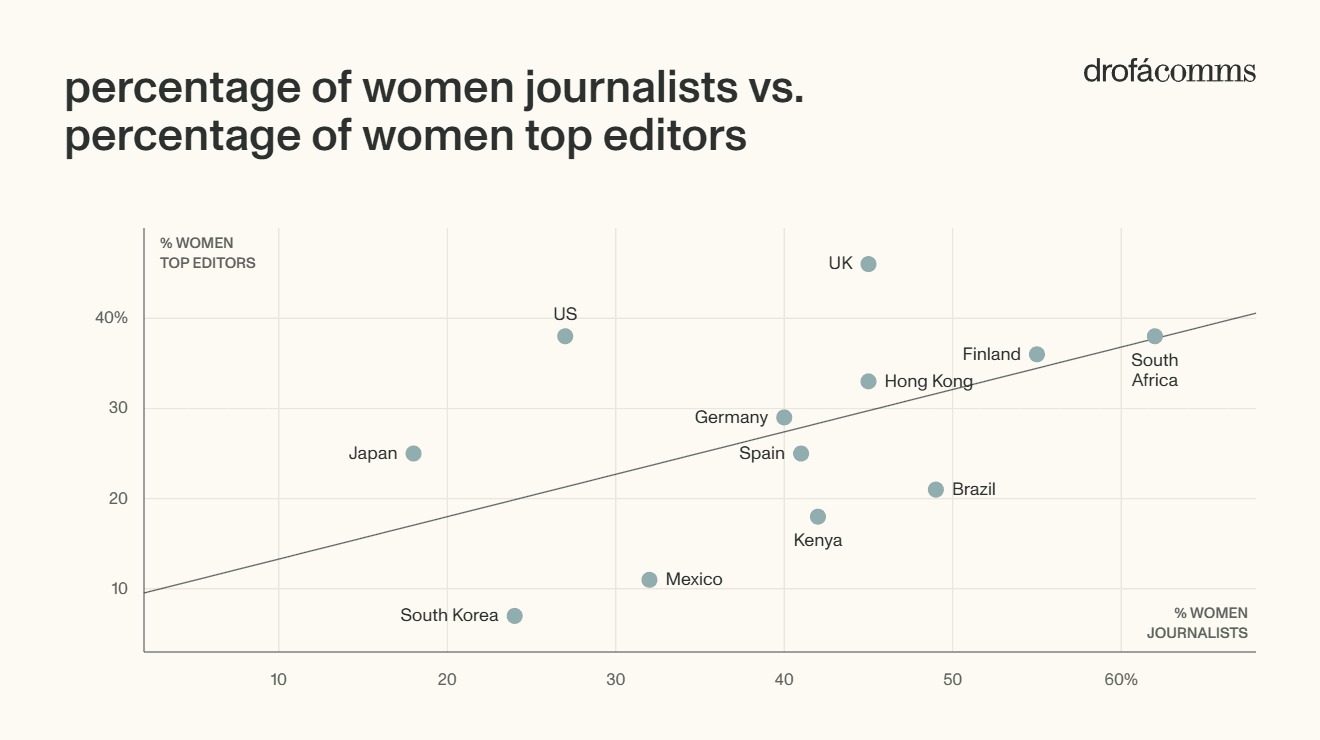
So, to dive deeper, the Reuters Institute analysed 240 of the largest online and offline publications in 12 countries on five continents. And the result of their research showed that only 27% of the 171 editors-in-chief in 240 outlets were women. And this is despite the fact that, on average, 40% of journalists in these 12 countries are women.

This makes it clear that there is a gap between women in ordinary roles and senior leadership, just like in other sectors beyond journalism. Put simply, the majority of editors-in-chief are men, including in countries where there are more women among working journalists. And even where there are many women in the profession, it's mostly men who make their way up.
The Spread Between Countries and Gender Inequality
Although the conclusions were more or less the same across all these countries, the situation varies greatly from market to market. For your understanding, the countries analysed in the paper were from different continents:
Africa: Kenya, South Africa
Asia: Hong Kong, Japan, South Korea
Europe: Finland, Germany, Spain, United Kingdom
North America: Mexico, USA
South America: Brazil
Women hold between 7% of leadership positions in South Korea and 46% in the UK. This year, the UK overtook the US in the share of female editors for the first time. The US now ranks second, following three years of decline, while South Africa takes the top spot.
The difference is also visible in the audience. The proportion of readers who receive news from at least one major publication with a woman at its head varies from 74% in Finland and Hong Kong to 23% in Mexico. In some countries, the reader is almost certainly confronted with a female-led publication, but in others, it is rather an exception.
Beyond that, the study also declines another frequent assumption — that the editorial gap simply reflects the overall level of gender inequality in the country.
In a study, there is only a weak positive relationship between the proportion of women among journalists and the proportion of women in leadership positions. In 9 out of 12 countries, there are fewer women among top editors than among journalists in general.
But the relationship between the general level of gender equality in society and the proportion of women among top editors has not been found at all. In other words, countries with good performance on the UN Gender Inequality Index do not necessarily have more women at the head of editorial offices — the problem is specific to journalism as an industry.
Not a Matter of Women’s Personal Choice
Coming back to the gap in women’s representation in the media, we can now say that it is not simply because there are too few women in journalism or because women experts choose not to comment.
The bigger issue is who has the power to decide what gets published and who gets invited to speak.
Men are still more likely to hold senior editorial and management positions. And this actually matters, because it is top editors and managers who often decide which topics are worth covering and which experts are worth inviting. When these decisions are mostly made by men, women can be less likely to be considered as experts or sources in the first place.
And women are still much less likely to reach these top positions. According to the same research, the proportion of women among top editors increased from only 23% in 2020 to 28% in 2025 in ten countries with long-term observations, and in some countries the figure has decreased over the past five years, despite the overall positive trend in the sample as a whole.
So the problem sounds this way: fewer women in senior editorial roles means fewer women influencing editorial decisions, which can mean fewer women being featured in the media.
This is why the gap cannot be explained simply by individual choices. It is also about the structure of newsrooms and the career barriers that women face inside them. Research has documented these gender imbalances for years.
The same logic applies to the question of who is seen as a go-to expert. Editors and journalists often return to familiar networks and established pools of speakers. If those networks are already dominated by men, the same names and voices continue to appear again and again.
It is similar to the problem of scoring that we have recently discussed — when the database is already male-skewed, the same would be the result.
In other words, the imbalance can start long before a journalist picks up the phone to call an expert.
Conclusion
So, the data also suggests that the problem is bigger than a simple lack of female voices in the media. When women are consistently less visible as experts and commentators, it also means that audiences are getting a narrower range of perspectives on the issues being discussed.
How to fix that gap and let women express more opinions? The way out is creating a media environment where women have a more equal chance to be invited and eventually become part of the group of voices journalists turn to by default.
Have you ever noticed that when you open the feature section in any media, females appear there less often than males? That’s no coincidence, and editorial teams have noticed it too.
When they examine why there are few women in the media quotes in the material, there is often one explanation. Female experts themselves are less likely to agree to comments, journalists say.
But at Drofa Comms, we think this explanation is incomplete. It removes the issue from the very structure of editorial offices and transfers it to the personal choice of individual women.
Recent data from the Reuters Institute supports our opinion and shows that the problem goes much deeper than simply refusing to give interviews. According to the research, it begins where decisions are made about topics, formats, and lists of experts — that is, at the level of management.
What Does the Data on 12 Markets Show?
If we summarise the paper's results briefly, it shows that the lack of women in the media is not due to them being less likely to agree to speak with journalists. Individual cases do happen, of course, but they do not explain the gap, which international studies have documented year after year.
So, to dive deeper, the Reuters Institute analysed 240 of the largest online and offline publications in 12 countries on five continents. And the result of their research showed that only 27% of the 171 editors-in-chief in 240 outlets were women. And this is despite the fact that, on average, 40% of journalists in these 12 countries are women.
This makes it clear that there is a gap between women in ordinary roles and senior leadership, just like in other sectors beyond journalism. Put simply, the majority of editors-in-chief are men, including in countries where there are more women among working journalists. And even where there are many women in the profession, it's mostly men who make their way up.
The Spread Between Countries and Gender Inequality
Although the conclusions were more or less the same across all these countries, the situation varies greatly from market to market. For your understanding, the countries analysed in the paper were from different continents:
Africa: Kenya, South Africa
Asia: Hong Kong, Japan, South Korea
Europe: Finland, Germany, Spain, United Kingdom
North America: Mexico, USA
South America: Brazil
Women hold between 7% of leadership positions in South Korea and 46% in the UK. This year, the UK overtook the US in the share of female editors for the first time. The US now ranks second, following three years of decline, while South Africa takes the top spot.
The difference is also visible in the audience. The proportion of readers who receive news from at least one major publication with a woman at its head varies from 74% in Finland and Hong Kong to 23% in Mexico. In some countries, the reader is almost certainly confronted with a female-led publication, but in others, it is rather an exception.
Beyond that, the study also declines another frequent assumption — that the editorial gap simply reflects the overall level of gender inequality in the country.
In a study, there is only a weak positive relationship between the proportion of women among journalists and the proportion of women in leadership positions. In 9 out of 12 countries, there are fewer women among top editors than among journalists in general.
But the relationship between the general level of gender equality in society and the proportion of women among top editors has not been found at all. In other words, countries with good performance on the UN Gender Inequality Index do not necessarily have more women at the head of editorial offices — the problem is specific to journalism as an industry.
Not a Matter of Women’s Personal Choice
Coming back to the gap in women’s representation in the media, we can now say that it is not simply because there are too few women in journalism or because women experts choose not to comment.
The bigger issue is who has the power to decide what gets published and who gets invited to speak.
Men are still more likely to hold senior editorial and management positions. And this actually matters, because it is top editors and managers who often decide which topics are worth covering and which experts are worth inviting. When these decisions are mostly made by men, women can be less likely to be considered as experts or sources in the first place.
And women are still much less likely to reach these top positions. According to the same research, the proportion of women among top editors increased from only 23% in 2020 to 28% in 2025 in ten countries with long-term observations, and in some countries the figure has decreased over the past five years, despite the overall positive trend in the sample as a whole.
So the problem sounds this way: fewer women in senior editorial roles means fewer women influencing editorial decisions, which can mean fewer women being featured in the media.
This is why the gap cannot be explained simply by individual choices. It is also about the structure of newsrooms and the career barriers that women face inside them. Research has documented these gender imbalances for years.
The same logic applies to the question of who is seen as a go-to expert. Editors and journalists often return to familiar networks and established pools of speakers. If those networks are already dominated by men, the same names and voices continue to appear again and again.
It is similar to the problem of scoring that we have recently discussed — when the database is already male-skewed, the same would be the result.
In other words, the imbalance can start long before a journalist picks up the phone to call an expert.
Conclusion
So, the data also suggests that the problem is bigger than a simple lack of female voices in the media. When women are consistently less visible as experts and commentators, it also means that audiences are getting a narrower range of perspectives on the issues being discussed.
How to fix that gap and let women express more opinions? The way out is creating a media environment where women have a more equal chance to be invited and eventually become part of the group of voices journalists turn to by default.
London office
Rise, created by Barclays, 41 Luke St, London EC2A 4DP
Nicosia office
2043, Nikokreontos 29, office 202
DP FINANCE COMM LTD (#13523955) Registered Address: N1 7GU, 20-22 Wenlock Road, London, United Kingdom For Operations In The UK
AGAFIYA CONSULTING LTD (#HE 380737) Registered Address: 2043, Nikokreontos 29, Flat 202, Strovolos, Cyprus For Operations In The EU, LATAM, United Stated Of America And Provision Of Services Worldwide
Drofa © 2024
London office
Rise, created by Barclays, 41 Luke St, London EC2A 4DP
Nicosia office
2043, Nikokreontos 29, office 202
DP FINANCE COMM LTD (#13523955) Registered Address: N1 7GU, 20-22 Wenlock Road, London, United Kingdom For Operations In The UK
AGAFIYA CONSULTING LTD (#HE 380737) Registered Address: 2043, Nikokreontos 29, Flat 202, Strovolos, Cyprus For Operations In The EU, LATAM, United Stated Of America And Provision Of Services Worldwide
Drofa © 2024
