NEWS
NEWS
Is Removing Gender From the Model Also Remove the Bias?
Is Removing Gender From the Model Also Remove the Bias?

No, removing a gender field from a credit-scoring model does not stop gender bias in fintech scoring. Bias re-enters through proxy variables like device type, geolocation, and employment data, and through historical data that already under-represents women as reliable borrowers. A gender-blind model can still produce gender-unequal outcomes.
Modern fintech services score a user's ability to repay a loan based on phone data, geolocation, transaction history, device type, and digital behaviour. For those who have studied statistics, this sounds right, as the more data there is, the more accurate the model and the fairer the result.
But in reality, these data systematically reflect women's unequal access to phones, finance, etc. We wish it were a theoretical issue, but this is the conclusion of a study of interviews with data scientists at fintech companies working with ML scoring in low- and middle-income countries.
The researchers interviewed fintech companies developing ML models of alternative lending to explore how such tools impact financial inclusion and gender equality. The results were surprising and highlighted that gender bias continues to occur, even at the AI scoring model level.
A Gender-Blind Model Does Not Mean a Fair Model
In these fintech services, developers mostly adhere to a gender-blind approach, believing that ML is objective and the data reflects the truth. At first, it sounds logical. If the algorithm does not see gender as a feature, it cannot discriminate by gender. But this is an erroneous assumption for three reasons.
Firstly, the absence of a gender feature in the model does not remove its influence — it leaks through other variables, and we will discuss this in detail later. Secondly, the data itself, on which the model is trained, is initially gender biased.
And last but not least, the very access to the product itself, that is, who gets to the point of scoring at all, is also unevenly distributed. As we know, most women do not even have access to education, not to mention alternative borrowing infrastructure.
Taken together, these factors result in the problem that the teams do not analyse how gender-specific the data is. So, in the end, the tools do expand access to finance, but not equally for everyone.
According to respondents who participated in the research, women are less likely to receive loans. In case they are approved, they get smaller amounts compared to men, despite the fact that they more often regularly repay the debt and are more careful with money.
How Gender Bias in Fintech Scoring Seeps in Through Proxies
Considering the first issue that we mentioned, gender bias indeed seeps into the model through other variables. Specifically, it does so through proxies.
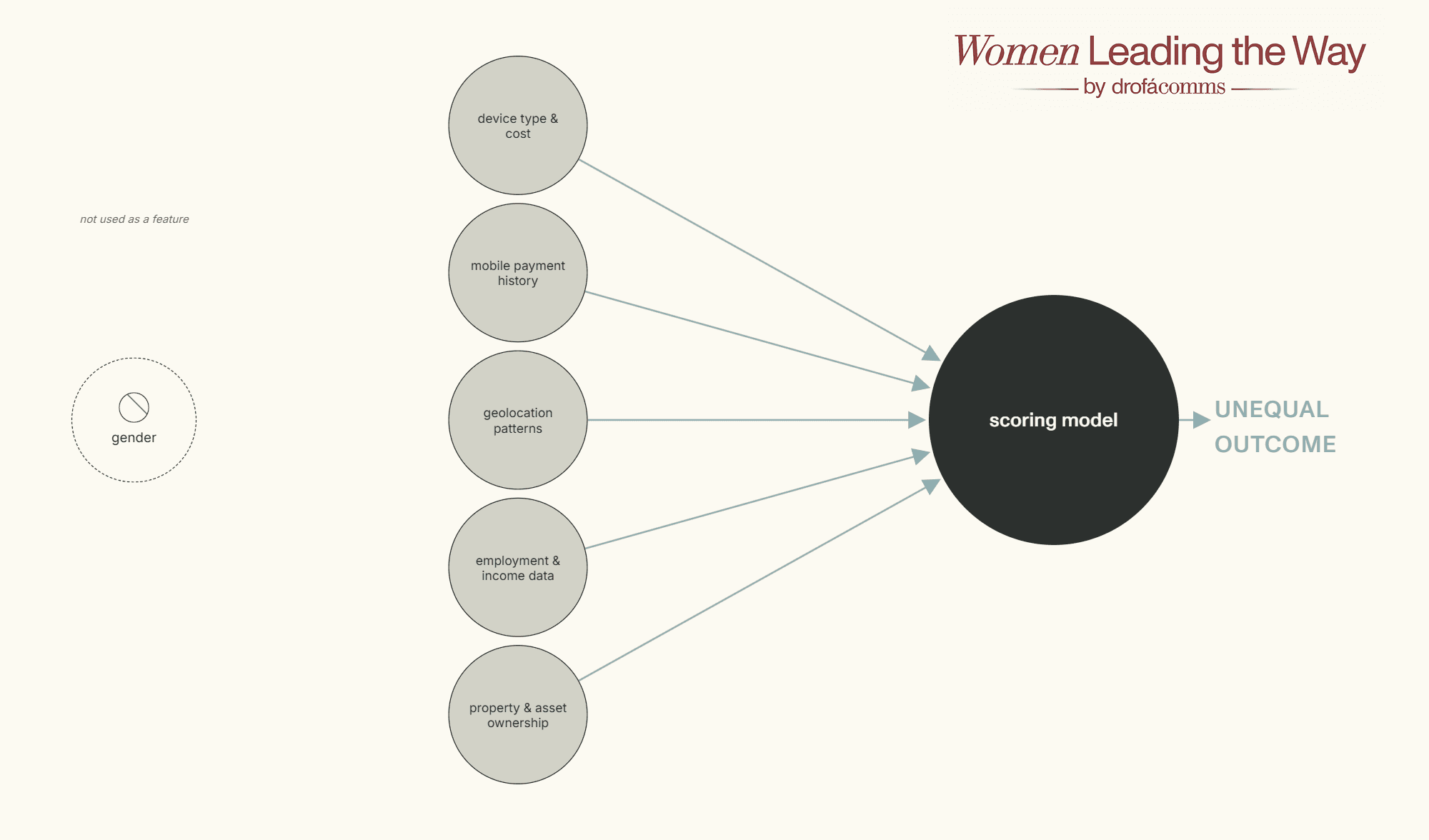
A proxy variable is not formally a protected trait (gender, race, age), but it statistically correlates with it and performs the same discriminating function. Put simply, a proxy is an indirect factor that still influences the model outcome. In fintech scoring, typical proxies look like this:
Device type and cost — women are less likely to own expensive or new smartphones in person, and more likely to use a shared family phone.
The history of mobile payments and the volume of traffic depend on who in the family officially owns the SIM card and the tariff.
Geolocation patterns — limited mobility (fewer trips, shorter travel radius) may reflect social and household constraints rather than "risk."
Employment and income data — women are more often employed in the informal sector, which reduces the visibility of income for the model.
Ownership of property and assets registered in the user's name is more often legally and culturally registered to men.
As a result, a model that has never seen the gender field is still able to reproduce gender inequality, simply through a combination of such indirect signals.
Historically Unequal Data Sets
Even if it were possible to remove all proxy features from the model, there would still be traces of a gender bias. If women have historically been less likely to have access to bank accounts, the training sample structurally underestimates their visibility as reliable borrowers.
The authors introduce the concept of encoded gender norms. It explains that without explicit attention to the gender nature of data and algorithm design, AI tools reproduce existing inequalities. Unfortunately, this turns the algorithm into a self-fulfilling prediction.
Women have historically been given fewer loans → There are fewer examples of successful repayment of large sums by women → The model is trained to give women fewer loans → and the cycle repeats.
Model Fairness vs Outcome Fairness
Proxy variables explain what the inequality is filtering through, and historical data explains where it comes from. But only the difference between model fairness and outcome fairness explains why companies don't notice this. That said, they are measuring, in fact, the wrong thing.
Model fairness is a property of the algorithm itself — whether it uses explicitly protected features, whether it is calibrated equally for different groups, whether errors of the first and second kind differ by subgroups at the testing stage. By this factor, the gender-blind model from the first section looks flawless — there is literally no gender field in it.
Outcome fairness is a result in the real world. This means who actually gets the loan and at what percentage. It is at this level that the consequences of proxy variables are visible. The model is technically fair, but the input (who is applying at all, who has which device, whose transaction history is richer) is already gender-skewed, so the result is skewed too.
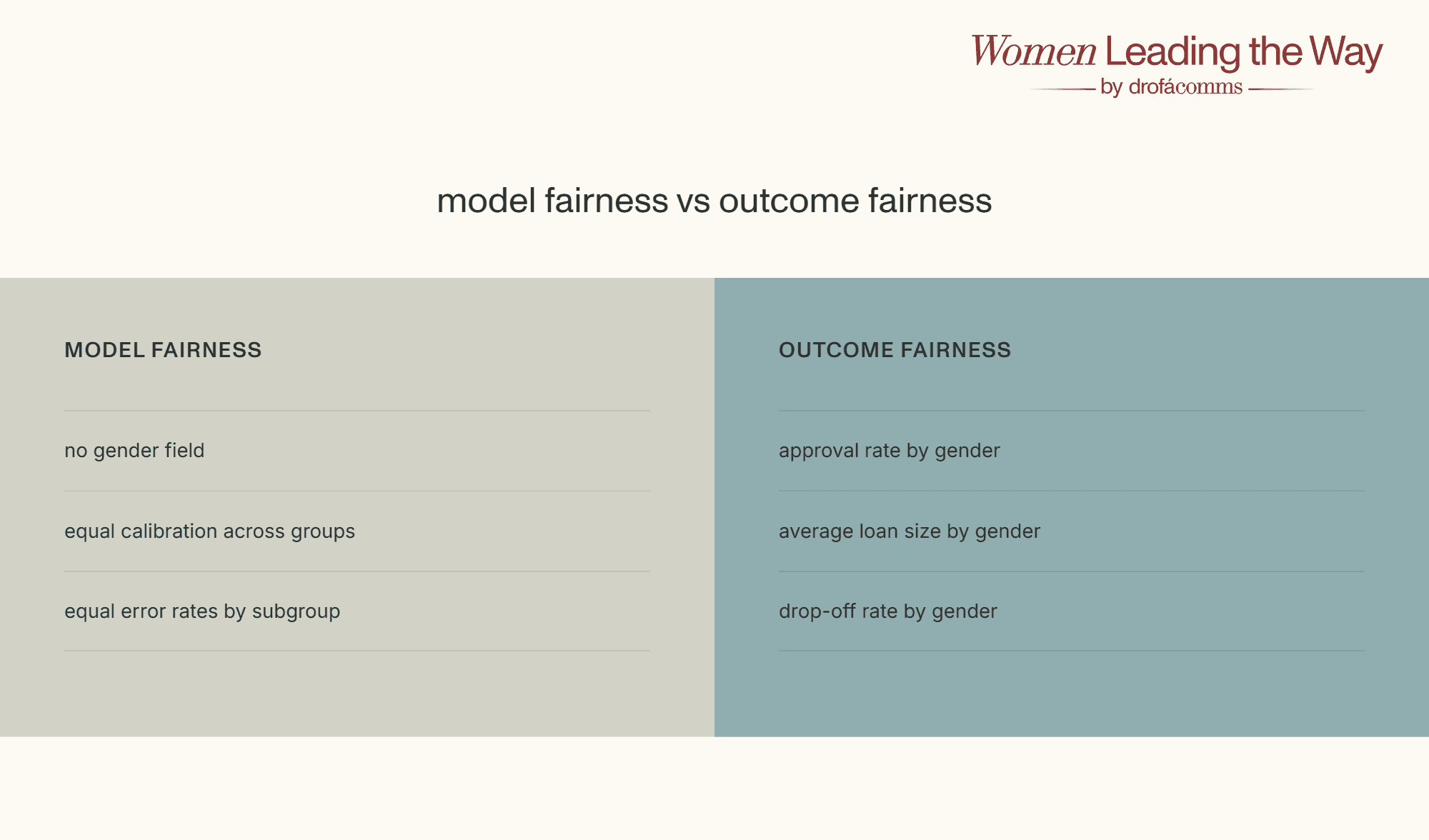
Fintech companies in these developing areas state that they are not responsible for that precisely because they look at the fairness of the model rather than the fairness of the final credit allocation. Technically, they are right, as it is the model that reproduces this discrimination, not fintech. But is it honest?
Which Gender-Disparate Metrics Should Fintechs Use?
However, fintechs and ML developers, specifically, can have a hand in solving this problem. For outcome fairness to be measurable, companies should regularly publish gender-disaggregated metrics (at least in internal analytics and regulatory reporting):
Approval rate by gender — the percentage of approved applications among men and women with comparable other characteristics.
The average approved limit — compares loan amounts between men and women with a similar credit profile.
The default rate and the gender repayment rate — the real repayment history, not the forecast of the model.
Drop-off rate at different stages of the funnel — how many women and men fail to reach scoring due to device, document, or verification requirements.
The difference in the interest rate at the same level of risk.
Feature importance by subgroup — which features most strongly influence the decision for women and men separately, in order to identify hidden proxy effects.
Calibration of the model by gender — whether the predicted probability of default coincides with the actual one separately for each group.
This way, using gender could become an audit feature. And it will differ in the future outputs, as it will check the decision for a gender effect after it is made.
Conclusion
The only way to break this discriminating circle is not to try to make the model even more blind, but to make its result transparent. Companies should start measuring outcomes directly through gender-disparate metrics, without waiting for the asymmetry in the data to correct itself.
As we discussed, a technically neutral model does not guarantee a neutral result. As long as data, devices, employment, and mobility are unevenly distributed between men and women, any algorithm trained on this data will replicate existing inequalities — simply through more complex and less visible channels.
No, removing a gender field from a credit-scoring model does not stop gender bias in fintech scoring. Bias re-enters through proxy variables like device type, geolocation, and employment data, and through historical data that already under-represents women as reliable borrowers. A gender-blind model can still produce gender-unequal outcomes.
Modern fintech services score a user's ability to repay a loan based on phone data, geolocation, transaction history, device type, and digital behaviour. For those who have studied statistics, this sounds right, as the more data there is, the more accurate the model and the fairer the result.
But in reality, these data systematically reflect women's unequal access to phones, finance, etc. We wish it were a theoretical issue, but this is the conclusion of a study of interviews with data scientists at fintech companies working with ML scoring in low- and middle-income countries.
The researchers interviewed fintech companies developing ML models of alternative lending to explore how such tools impact financial inclusion and gender equality. The results were surprising and highlighted that gender bias continues to occur, even at the AI scoring model level.
A Gender-Blind Model Does Not Mean a Fair Model
In these fintech services, developers mostly adhere to a gender-blind approach, believing that ML is objective and the data reflects the truth. At first, it sounds logical. If the algorithm does not see gender as a feature, it cannot discriminate by gender. But this is an erroneous assumption for three reasons.
Firstly, the absence of a gender feature in the model does not remove its influence — it leaks through other variables, and we will discuss this in detail later. Secondly, the data itself, on which the model is trained, is initially gender biased.
And last but not least, the very access to the product itself, that is, who gets to the point of scoring at all, is also unevenly distributed. As we know, most women do not even have access to education, not to mention alternative borrowing infrastructure.
Taken together, these factors result in the problem that the teams do not analyse how gender-specific the data is. So, in the end, the tools do expand access to finance, but not equally for everyone.
According to respondents who participated in the research, women are less likely to receive loans. In case they are approved, they get smaller amounts compared to men, despite the fact that they more often regularly repay the debt and are more careful with money.
How Gender Bias in Fintech Scoring Seeps in Through Proxies
Considering the first issue that we mentioned, gender bias indeed seeps into the model through other variables. Specifically, it does so through proxies.
A proxy variable is not formally a protected trait (gender, race, age), but it statistically correlates with it and performs the same discriminating function. Put simply, a proxy is an indirect factor that still influences the model outcome. In fintech scoring, typical proxies look like this:
Device type and cost — women are less likely to own expensive or new smartphones in person, and more likely to use a shared family phone.
The history of mobile payments and the volume of traffic depend on who in the family officially owns the SIM card and the tariff.
Geolocation patterns — limited mobility (fewer trips, shorter travel radius) may reflect social and household constraints rather than "risk."
Employment and income data — women are more often employed in the informal sector, which reduces the visibility of income for the model.
Ownership of property and assets registered in the user's name is more often legally and culturally registered to men.
As a result, a model that has never seen the gender field is still able to reproduce gender inequality, simply through a combination of such indirect signals.
Historically Unequal Data Sets
Even if it were possible to remove all proxy features from the model, there would still be traces of a gender bias. If women have historically been less likely to have access to bank accounts, the training sample structurally underestimates their visibility as reliable borrowers.
The authors introduce the concept of encoded gender norms. It explains that without explicit attention to the gender nature of data and algorithm design, AI tools reproduce existing inequalities. Unfortunately, this turns the algorithm into a self-fulfilling prediction.
Women have historically been given fewer loans → There are fewer examples of successful repayment of large sums by women → The model is trained to give women fewer loans → and the cycle repeats.
Model Fairness vs Outcome Fairness
Proxy variables explain what the inequality is filtering through, and historical data explains where it comes from. But only the difference between model fairness and outcome fairness explains why companies don't notice this. That said, they are measuring, in fact, the wrong thing.
Model fairness is a property of the algorithm itself — whether it uses explicitly protected features, whether it is calibrated equally for different groups, whether errors of the first and second kind differ by subgroups at the testing stage. By this factor, the gender-blind model from the first section looks flawless — there is literally no gender field in it.
Outcome fairness is a result in the real world. This means who actually gets the loan and at what percentage. It is at this level that the consequences of proxy variables are visible. The model is technically fair, but the input (who is applying at all, who has which device, whose transaction history is richer) is already gender-skewed, so the result is skewed too.
Fintech companies in these developing areas state that they are not responsible for that precisely because they look at the fairness of the model rather than the fairness of the final credit allocation. Technically, they are right, as it is the model that reproduces this discrimination, not fintech. But is it honest?
Which Gender-Disparate Metrics Should Fintechs Use?
However, fintechs and ML developers, specifically, can have a hand in solving this problem. For outcome fairness to be measurable, companies should regularly publish gender-disaggregated metrics (at least in internal analytics and regulatory reporting):
Approval rate by gender — the percentage of approved applications among men and women with comparable other characteristics.
The average approved limit — compares loan amounts between men and women with a similar credit profile.
The default rate and the gender repayment rate — the real repayment history, not the forecast of the model.
Drop-off rate at different stages of the funnel — how many women and men fail to reach scoring due to device, document, or verification requirements.
The difference in the interest rate at the same level of risk.
Feature importance by subgroup — which features most strongly influence the decision for women and men separately, in order to identify hidden proxy effects.
Calibration of the model by gender — whether the predicted probability of default coincides with the actual one separately for each group.
This way, using gender could become an audit feature. And it will differ in the future outputs, as it will check the decision for a gender effect after it is made.
Conclusion
The only way to break this discriminating circle is not to try to make the model even more blind, but to make its result transparent. Companies should start measuring outcomes directly through gender-disparate metrics, without waiting for the asymmetry in the data to correct itself.
As we discussed, a technically neutral model does not guarantee a neutral result. As long as data, devices, employment, and mobility are unevenly distributed between men and women, any algorithm trained on this data will replicate existing inequalities — simply through more complex and less visible channels.
London office
Rise, created by Barclays, 41 Luke St, London EC2A 4DP
Nicosia office
2043, Nikokreontos 29, office 202
DP FINANCE COMM LTD (#13523955) Registered Address: N1 7GU, 20-22 Wenlock Road, London, United Kingdom For Operations In The UK
AGAFIYA CONSULTING LTD (#HE 380737) Registered Address: 2043, Nikokreontos 29, Flat 202, Strovolos, Cyprus For Operations In The EU, LATAM, United Stated Of America And Provision Of Services Worldwide
Drofa © 2024
London office
Rise, created by Barclays, 41 Luke St, London EC2A 4DP
Nicosia office
2043, Nikokreontos 29, office 202
DP FINANCE COMM LTD (#13523955) Registered Address: N1 7GU, 20-22 Wenlock Road, London, United Kingdom For Operations In The UK
AGAFIYA CONSULTING LTD (#HE 380737) Registered Address: 2043, Nikokreontos 29, Flat 202, Strovolos, Cyprus For Operations In The EU, LATAM, United Stated Of America And Provision Of Services Worldwide
Drofa © 2024
