NEWS
NEWS
What Web3 Maturity in 2026 Really Looks Like: 7 Women Building LATAM's Next Digital Economy
What Web3 Maturity in 2026 Really Looks Like: 7 Women Building LATAM's Next Digital Economy
In Web3, there are many countries throughout the world that take a bigger share of the industry than others, and Brazil is among them. In the 2025 Global Crypto Adoption Index, Brazil took 5th place, while the entire Latin American region grew by 63% year on year. Moreover, Brazil received around $318.8 billion in crypto value between July 2024 and June 2025, almost one-third of the regional total.
This confirms Brazil's position among the hubs where the Web3 industry is actively developing. Yet, for this growth to continue, there are still real problems the industry has to solve. Otherwise, further development could easily stall. This is especially important now that Web3 is already becoming part of payments, investment products, tokenisation and other financial services.
These were recurring themes in a special LATAM project by Women Leading the Way.
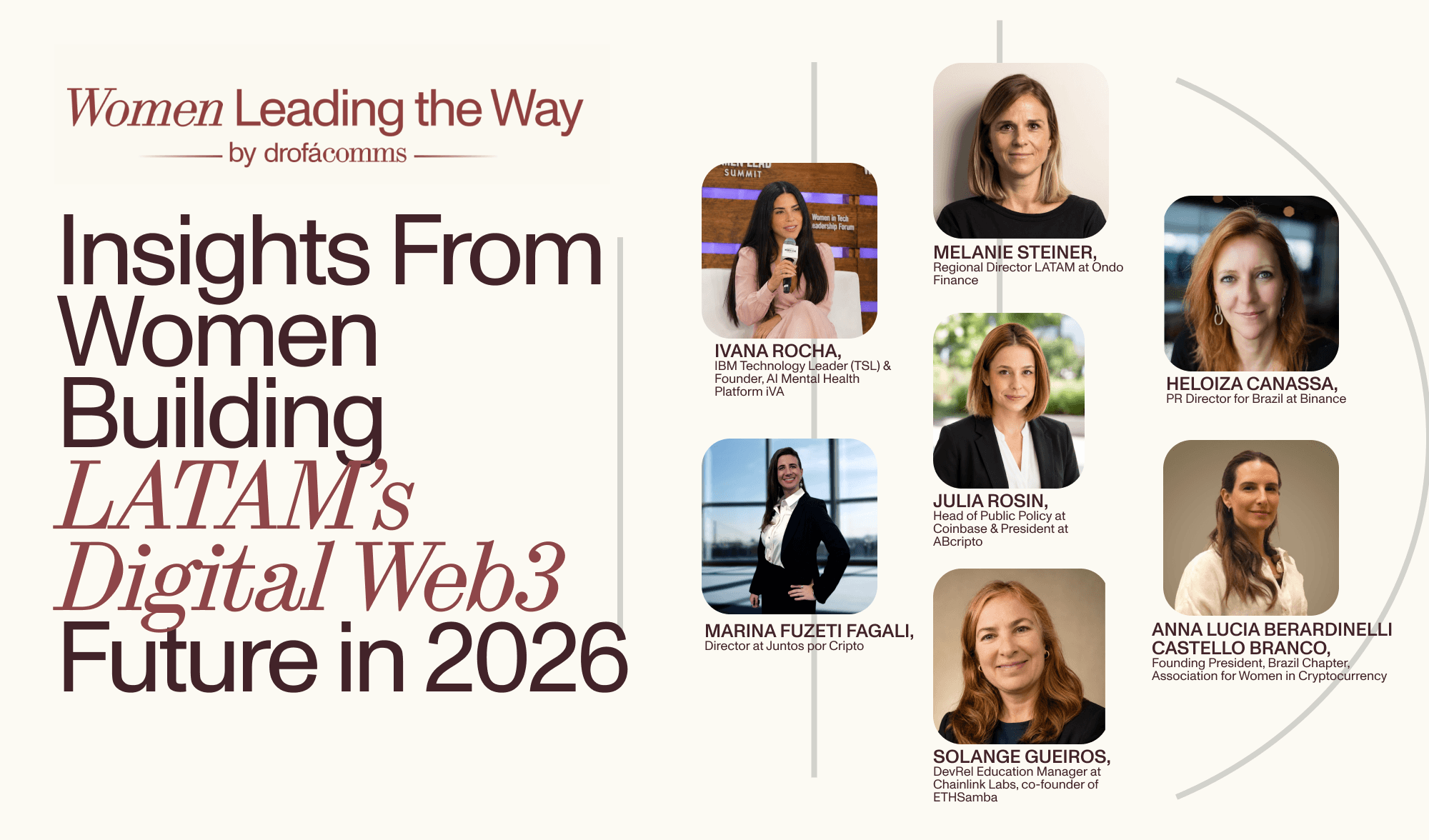
During Blockchain.RIO 2026, Graziella Cardeal, LATAM Market PR Lead at Drofa Comms, interviewed seven women whose careers cover very different corners of the digital economy: Melanie Steiner, Regional Director LATAM at Ondo Finance; Solange Gueiros, DevRel Education Manager at Chainlink Labs and ETHSamba co-founder; Heloiza Canassa, PR Director for Brazil at Binance; Julia Rosin, Coinbase’s Head of Public Policy in Brazil and President of ABCripto; Anna Lucia Berardinelli Castello Branco, Founding President of the Brazil Chapter of the Association for Women in Cryptocurrency; Marina Fuzeti Fagali, Director at Juntos por Cripto; and Ivana Rocha, IBM Technology Leader and founder of AI mental health platform iVA.
Their backgrounds could hardly be more different. They came into technology from marketing, journalism, law, government relations, sport, software education and corporate leadership. Yet their answers repeatedly return to the idea that a mature digital economy cannot be measured only by transaction volumes, institutional announcements or new products. It also depends on whether technology solves a recognisable problem, whether people trust the systems behind it and who gets to participate in deciding what comes next.
1. Melanie Steiner: Adoption Starts When the Technology Disappears
Melanie Steiner has watched several technology adoption cycles from inside the companies driving them. Before joining Ondo Finance, her career passed through global consumer brands, Mercado Libre, Mercado Pago and Binance. That gives her an unusually broad comparison between e-commerce, instant payments, crypto and tokenised assets.

The lesson she draws from those markets is the following:
“Every adoption wave I've worked on broke the same way: not when the technology got better, but when the user stopped needing to understand it.”
Steiner believes tokenisation is approaching a similar stage. Regulation has developed, infrastructure is no longer the main obstacle, institutional and retail interest now coexist, and products are appearing inside exchanges, wallets, fintech platforms and brokers that users already know.
That is especially relevant in Latin America, where financial technology is often adopted because it solves an immediate economic problem. Yet the reason differs dramatically from one country to another.
Brazilian users already have sophisticated expectations around payments and investments. In Argentina, digital assets can serve as tools for protecting savings from currency instability. Mexico has remittances, cash usage and its own regulatory dynamics, while Colombia and Peru have developed their own use cases around stablecoins and international commerce.
For companies entering the region, this makes translation the easy part. Understanding motivation is more difficult.
“Don't localise the language. Localise the reason to care.”
As for leadership, Steiner describes leaving Adidas and Puig for Mercado Libre as a “hard reset” in which she had to learn acquisition, conversion, retention and unit economics while managing people who knew parts of the business better than she did. Her response was to stop treating leadership as knowing everything herself.
“Let the expert be the expert. I am always honest about what I don't know, and confident about what I do.”
2. Solange Gueiros: Infrastructure Has to Work Under Real Conditions
If Steiner starts with what the user should not have to understand, Solange Gueiros looks directly underneath the product.
After more than 20 years in technology, Gueiros now works in developer education at Chainlink Labs and is a co-founder of ETHSamba. From her perspective, institutional blockchain adoption rests on requirements that are less visible to the end user but still very important: confidentiality, privacy, transaction capacity, finality, dependable data and communication between different systems.
A blockchain product may appear polished at the application level. Even so, that means little if the infrastructure cannot support business demand or if a company cannot determine when a transaction is genuinely irreversible.
“A blockchain with no connection to the real world has little utility. So, oracles are the foundation for a blockchain to exist in the real world.”
For financial applications, bringing outside data on-chain creates two separate questions: whether the information was accurate at its source and whether it remained intact while reaching the blockchain.
“Data must be reliable in two respects. First it should ensure that the original data is correct — which depends on the provider — and second, it should guarantee the integrity of how that data reaches the blockchain.”
The same applies to interoperability. Companies have different systems, rules and technological requirements, yet none of them exists in isolation. Institutional adoption therefore requires blockchains to communicate with existing infrastructure and, in many cases, with other networks.
Gueiros is more optimistic about Latin America’s developer base than narratives about a regional skills shortage might suggest. She sees Brazilian developers joining international companies, conferences and hackathons, and attributes part of that progress to education programmes already built in the region.
Her answer to women who feel they lack credentials is:
“If someone lacks credentials, the only way to acquire them is through dedication and study.”
From this discussion, we can conclude that talent is infrastructure too. Networks can process more transactions and institutions can build more products, but the industry still needs people capable of understanding, teaching and maintaining those systems.
3. Heloiza Canassa: Trust Is Also a Communications Problem
Technical reliability alone does not make a financial system trusted. Heloiza Canassa learned that much earlier in her career.
Before joining Binance as PR Director for Brazil, she spent more than a decade as a financial journalist and later worked as a PR adviser to the Governor of Brazil’s Central Bank. There, she saw how closely financial stability and communication can interact.

“I learned how a single message can calm markets or move them and how trust is really created in finance.”
The principle has followed her into crypto, an industry where public understanding often trails the speed at which products and terminology develop.
For Canassa, one challenge is public scrutiny. Crypto attracts firm opinions from people who may never have interacted with the technology directly. Another is the density of its language. Wallets, protocols, custody, tokenisation and smart contracts can easily turn communication into a closed conversation among people already inside the industry.
She compares the problem with explaining monetary policy or exchange rates. Both can appear abstract until someone connects them with a person’s daily financial life.
“Communication, when done well, informs and educates the public. It helps people understand decisions that affect their lives.”
That makes communications part of the trust infrastructure rather than something added after a product has been built. Users need to understand what they are doing, what can go wrong and why a financial product has any relevance to them.
The question of representation therefore connects directly with the question of trust. Canassa rejects the idea that women are absent from crypto. In her work, she sees women leading regions, building businesses and advising policymakers in Latin America. Still, she also acknowledges that the sector has further to go.
“Don't let the jargon intimidate you because it’s really just a gatekeeping tool. Once you're on the inside, you learn the language fast, and then realise that Web3 needs people who can speak beyond the jargon far more than those who speak it.”
So, a market cannot claim broad adoption while talking only to itself. As crypto reaches users who did not grow up in its developer culture, translating technical and economic complexity into language people can actually use will remain part of the work.
4. Julia Rosin: Institutional Adoption Depends on Rules People Can Trust
Julia Rosin, Coinbase’s Head of Public Policy in Brazil and President of ABCripto, works right where business, regulation and public policy intersect.
Her career began closer to government before moving into government-relations consulting, venture capital and eventually digital assets. That path taught her to look at regulation from several directions at once. A company may have its own priorities, but regulators, users, media and competing market participants all see the same issue differently.

Her dual role at Coinbase and ABCripto makes that particularly visible. Rosin explains that ABCripto’s bylaws prevent the association from taking up an issue unless it is relevant to at least three members. Coinbase is represented inside the association by other people, and conflicts can be handled by the vice-president rather than by Rosin herself.
“The regulator always knows which hat I'm wearing, and in both cases I'm accompanied by the relevant team. That transparency is what prevents any perception that I'm using the association to serve a personal interest.”
On anti-money-laundering standards, Rosin says companies initially built their own approaches instead of developing common practices and engaging law enforcement early enough.
“The market's mistake was not presenting itself proactively to law enforcement and taking too long to build common anti-money-laundering standards — every company built its own.”
Traditional finance, meanwhile, is no longer simply observing blockchain from outside. Rosin says major Brazilian banks are building blockchain infrastructure, particularly around tokenisation.
The reason, in her view, comes down to whether the technology solves something better than existing rails. Programmability, transparency and settlement efficiency provide reasons for experimentation, although she does not expect older financial infrastructure to disappear suddenly.
That observation also shapes how Rosin talks about women’s representation. She sees a contradiction in Brazil: several major financial and industry organisations have women as their public leaders, while the layers immediately below them remain considerably more male.
“Women are leading and publicly representing the market, without holding leadership positions inside member companies in the same proportion.”
Her own experience in policy rooms has often meant being both the youngest person and the only woman present. Earlier in her career, she was advised to dress conservatively, speak only when asked and keep stronger opinions for after meetings. She eventually concluded that following those rules would only reproduce them.
“If you know what you're talking about, there is no reason to stay silent.”
5. Anna Lucia Berardinelli Castello Branco: Innovation Needs Legal Certainty
Anna Lucia Berardinelli Castello Branco entered blockchain from law.
Her interest accelerated when she led the legal team of a company tokenising precatórios, Brazilian court-ordered government debt. She later worked on the Crypto Tax Offset project in Rio de Janeiro’s innovation sandbox, using technology to simplify tax-offset processes that had traditionally been complicated.

Those experiences showed her that tokenisation can change financial processes in meaningful ways. They also made the limitations obvious, as innovation becomes difficult to scale when companies do not know where legal responsibilities begin and end.
“For innovation to move forward with legal certainty, we need a clear regulatory framework that protects both investors and entrepreneurs.”
For Anna, regulation needs to establish responsibility, disclosure and investor-protection standards while giving companies enough predictability to keep developing products.
That requires regulators to stay close to what is actually being built.
“Regulation works best when it reflects how these products are actually designed, issued and used in the market, rather than being developed in isolation from the technology itself.”
She points to the Brazilian Securities and Exchange Commission’s Tokenisation Working Group as an encouraging example of regulators engaging with the realities of the market.
Yet the composition of those conversations matters as much as the fact that they are taking place.
Anna joined the Association for Women in Cryptocurrency’s Brazil Chapter because she saw persistent gaps in visibility and opportunity. Women, in her view, are making progress in marketing, sales and communications while remaining much less visible in software development, engineering and senior decision-making.
“There is still a huge gap in visibility and opportunities for women, and it is time to change that together.”
That imbalance has consequences outside the workplace itself. Regulation influences product design, investor protection and public confidence. When the same types of people dominate the discussion, some needs and risks can receive less attention.
“A genuine diversity of viewpoints is essential for creating a balanced and resilient ecosystem.”
Anna therefore places education and professional development alongside legal reform. Courses, workshops, support networks and greater professional visibility can help more women enter the industry, while technical preparation makes it easier for them to take part in the discussions where rules are formed.
6. Marina Fuzeti Fagali: Regulation Has to Hear the People Using the Technology
Marina Fuzeti Fagali approaches Web3 from public affairs, communications and community building.
Her career also includes sport, which she credits with teaching teamwork, resilience and collective effort. Later work in crypto and institutional relations added a different lesson: emerging markets often require people to take responsibility before established career models exist.
“Leadership means taking up space without waiting for permission. It also means opening paths even when there are no role models to follow.”
That principle is visible in her work with Juntos por Cripto.
Brazilian regulation is entering a decisive period, with debates involving stablecoins, asset segregation and Central Bank rules. For Fagali, however, the quality of these frameworks depends on who regulators actually hear from.
“The voice that still most needs to be heard is that of the community: people on the ground who use crypto every day and do not represent a company or institution.”
Companies and associations naturally have more resources to participate in formal policy discussions. Everyday users usually do not. That can leave policymakers with an incomplete picture of how products work in real life and why people use them.
Women face a similar problem when access to those discussions exists in theory but participation remains low in practice.
For Fagali, passive openness is not sufficient.
“Advocacy groups and associations cannot simply open doors passively; they need to build active bridges.”
She proposes concrete measures: fewer all-male panels, more government-relations training for women executives, stronger support networks and a deliberate effort to bring women into regulatory discussions as technical leaders rather than symbolic participants.
7. Ivana Rocha: Mature Technology Also Means Asking What the System Was Built On
Ivana Rocha brings a somewhat different perspective to this discussion.
Her current work extends outside crypto itself. Rocha is an IBM Technology Leader and founder of iVA, an AI mental health platform focused on women. Yet the questions she raises around data, governance and representation apply directly to the wider digital economy that blockchain is growing into.

Her career did not begin in engineering. Rocha built her background in marketing before moving deeper into technology, eventually working with highly technical software products. Instead of treating that earlier career as baggage she had to overcome, she found that product marketing had trained her to sit between technology, market needs and customer behaviour.
“You have to understand the technology, the market, the customer, and the problem the customer is actually trying to solve. You have to be able to translate between all of them.”
That combination later fed into iVA.
The project grew from Rocha’s own experience and from watching women in her family deal with difficult mental-health circumstances. She began investigating the relationship between mental health, biology, hormones, personal experiences and environment, using technology and AI to organise information and identify questions she had not previously known to ask.
“Technology is what I know now. Why wouldn't I use it to work on this problem?”
For Rocha, however, applying AI to a sensitive field means governance cannot be postponed until the product is already in use. Data provenance, lineage, security, privacy, explainability, testing and human oversight all have to be considered early.
Rocha sees technology as a way to address some inherited gaps.
“Responsible AI is also an opportunity to use technology to address some of the gaps we inherited from the systems that came before it.”
That argument is relevant well outside health technology. Blockchain, tokenisation and AI are often discussed as separate markets, yet they share the same basic governance problem:. It includes technical systems that encode assumptions about their users, their data and the people designing them.
Few people working in Web3 today trained specifically for the roles they now hold. The sector has been built by people moving from finance, law, public policy, engineering, journalism, marketing and countless other disciplines. Its next phase will probably require even more of that cross-pollination.
Conclusion: Maturity Is What Happens After the Hype
Taken together, these seven conversations describe a market dealing with a different set of questions than it did a few years ago.
Melanie Steiner sees adoption accelerating when users no longer need to think about the technology underneath a product. Solange Gueiros points to the infrastructure, data and technical education required to make those products dependable. Heloiza Canassa shows why communication determines whether people can understand and trust what they are being offered.
Julia Rosin and Anna Lucia Berardinelli Castello Branco approach the same question from regulation: markets need standards, institutional cooperation and legal certainty if they are expected to handle more capital and more users. Marina Fuzeti Fagali adds that regulation and product development cannot represent the market properly if the community itself remains outside the room. Ivana Rocha takes the argument one layer deeper by asking what data, assumptions and human experiences technology is built on in the first place.
Their views also complicate the usual discussion about women in Web3.
Women are already leading associations, working with regulators, teaching developers, building products, directing communications and representing major global companies in Brazil. The remaining problem is uneven access. Technical teams, corporate decision-making positions and many policy environments still do not reflect the same level of representation visible among some of the sector’s public leaders.
Fixing that requires investing in technical education, creating routes into senior roles, putting experts in front of decision-makers, making promotion criteria understandable and giving people the confidence and authority to speak about the subjects they know.
Therefore, Brazil’s next stage of Web3 development will be shaped by two things at once: whether its technology can disappear into products people genuinely need, and whether the institutions growing around that technology can earn enough trust to last.
That is also the reason Women Leading the Way exists. Expertise already exists in the market. The task is to make sure more of it is visible, heard and present in the discussions deciding what the next version of finance and technology will look like.
Acknowledgement: the Drofa Comms team is thankful to Melanie Steiner, Solange Gueiros, Anna Lucia Berardinelli Castello Branco, Marina Fuzeti Fagali, Julia Rosin, Heloiza Canassa and Ivana Rocha for contributing their perspectives to this Women Leading the Way article.
In Web3, there are many countries throughout the world that take a bigger share of the industry than others, and Brazil is among them. In the 2025 Global Crypto Adoption Index, Brazil took 5th place, while the entire Latin American region grew by 63% year on year. Moreover, Brazil received around $318.8 billion in crypto value between July 2024 and June 2025, almost one-third of the regional total.
This confirms Brazil's position among the hubs where the Web3 industry is actively developing. Yet, for this growth to continue, there are still real problems the industry has to solve. Otherwise, further development could easily stall. This is especially important now that Web3 is already becoming part of payments, investment products, tokenisation and other financial services.
These were recurring themes in a special LATAM project by Women Leading the Way.
During Blockchain.RIO 2026, Graziella Cardeal, LATAM Market PR Lead at Drofa Comms, interviewed seven women whose careers cover very different corners of the digital economy: Melanie Steiner, Regional Director LATAM at Ondo Finance; Solange Gueiros, DevRel Education Manager at Chainlink Labs and ETHSamba co-founder; Heloiza Canassa, PR Director for Brazil at Binance; Julia Rosin, Coinbase’s Head of Public Policy in Brazil and President of ABCripto; Anna Lucia Berardinelli Castello Branco, Founding President of the Brazil Chapter of the Association for Women in Cryptocurrency; Marina Fuzeti Fagali, Director at Juntos por Cripto; and Ivana Rocha, IBM Technology Leader and founder of AI mental health platform iVA.
Their backgrounds could hardly be more different. They came into technology from marketing, journalism, law, government relations, sport, software education and corporate leadership. Yet their answers repeatedly return to the idea that a mature digital economy cannot be measured only by transaction volumes, institutional announcements or new products. It also depends on whether technology solves a recognisable problem, whether people trust the systems behind it and who gets to participate in deciding what comes next.
1. Melanie Steiner: Adoption Starts When the Technology Disappears
Melanie Steiner has watched several technology adoption cycles from inside the companies driving them. Before joining Ondo Finance, her career passed through global consumer brands, Mercado Libre, Mercado Pago and Binance. That gives her an unusually broad comparison between e-commerce, instant payments, crypto and tokenised assets.
The lesson she draws from those markets is the following:
“Every adoption wave I've worked on broke the same way: not when the technology got better, but when the user stopped needing to understand it.”
Steiner believes tokenisation is approaching a similar stage. Regulation has developed, infrastructure is no longer the main obstacle, institutional and retail interest now coexist, and products are appearing inside exchanges, wallets, fintech platforms and brokers that users already know.
That is especially relevant in Latin America, where financial technology is often adopted because it solves an immediate economic problem. Yet the reason differs dramatically from one country to another.
Brazilian users already have sophisticated expectations around payments and investments. In Argentina, digital assets can serve as tools for protecting savings from currency instability. Mexico has remittances, cash usage and its own regulatory dynamics, while Colombia and Peru have developed their own use cases around stablecoins and international commerce.
For companies entering the region, this makes translation the easy part. Understanding motivation is more difficult.
“Don't localise the language. Localise the reason to care.”
As for leadership, Steiner describes leaving Adidas and Puig for Mercado Libre as a “hard reset” in which she had to learn acquisition, conversion, retention and unit economics while managing people who knew parts of the business better than she did. Her response was to stop treating leadership as knowing everything herself.
“Let the expert be the expert. I am always honest about what I don't know, and confident about what I do.”
2. Solange Gueiros: Infrastructure Has to Work Under Real Conditions
If Steiner starts with what the user should not have to understand, Solange Gueiros looks directly underneath the product.
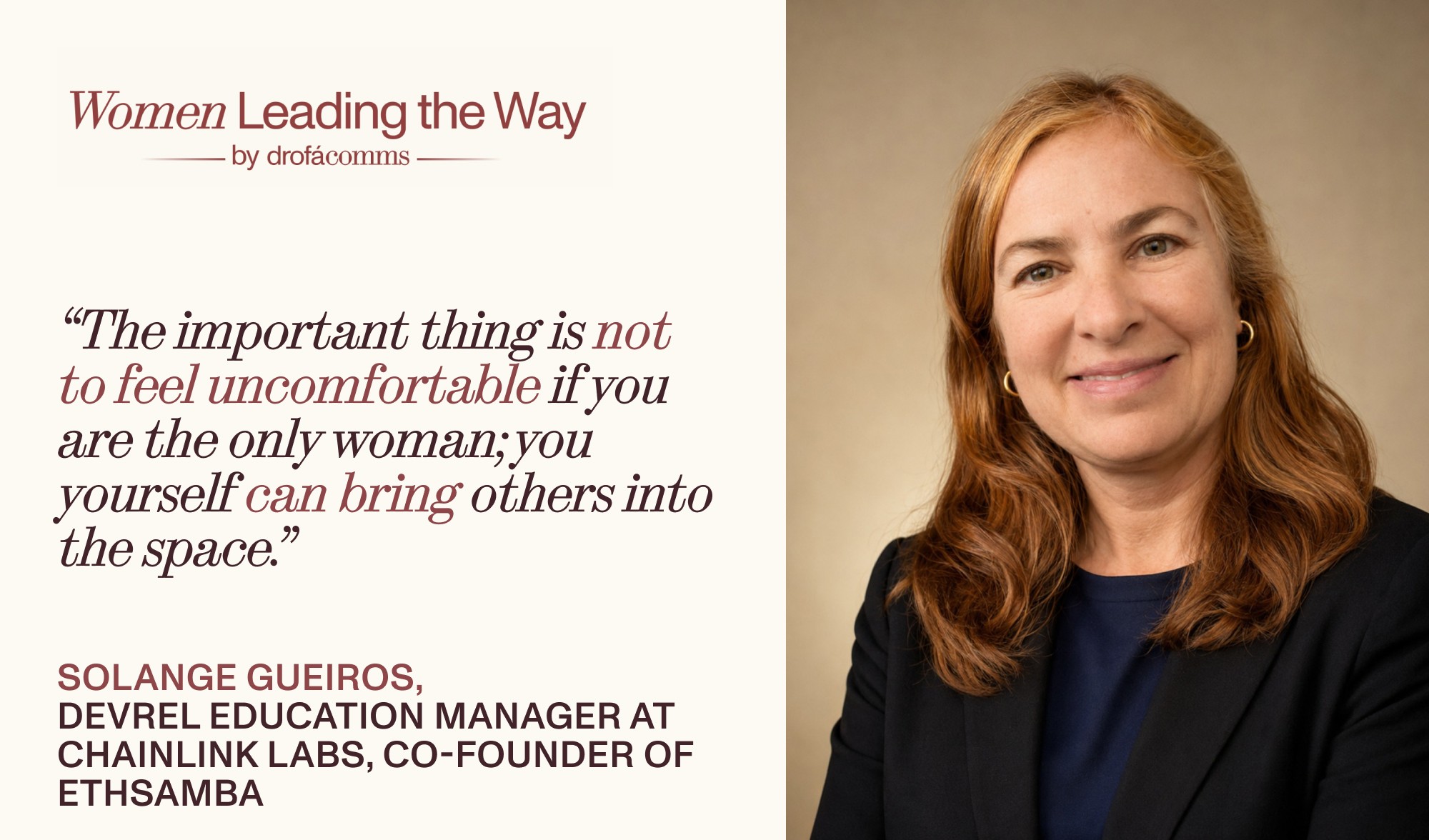
After more than 20 years in technology, Gueiros now works in developer education at Chainlink Labs and is a co-founder of ETHSamba. From her perspective, institutional blockchain adoption rests on requirements that are less visible to the end user but still very important: confidentiality, privacy, transaction capacity, finality, dependable data and communication between different systems.
A blockchain product may appear polished at the application level. Even so, that means little if the infrastructure cannot support business demand or if a company cannot determine when a transaction is genuinely irreversible.
“A blockchain with no connection to the real world has little utility. So, oracles are the foundation for a blockchain to exist in the real world.”
For financial applications, bringing outside data on-chain creates two separate questions: whether the information was accurate at its source and whether it remained intact while reaching the blockchain.
“Data must be reliable in two respects. First it should ensure that the original data is correct — which depends on the provider — and second, it should guarantee the integrity of how that data reaches the blockchain.”
The same applies to interoperability. Companies have different systems, rules and technological requirements, yet none of them exists in isolation. Institutional adoption therefore requires blockchains to communicate with existing infrastructure and, in many cases, with other networks.
Gueiros is more optimistic about Latin America’s developer base than narratives about a regional skills shortage might suggest. She sees Brazilian developers joining international companies, conferences and hackathons, and attributes part of that progress to education programmes already built in the region.
Her answer to women who feel they lack credentials is:
“If someone lacks credentials, the only way to acquire them is through dedication and study.”
From this discussion, we can conclude that talent is infrastructure too. Networks can process more transactions and institutions can build more products, but the industry still needs people capable of understanding, teaching and maintaining those systems.
3. Heloiza Canassa: Trust Is Also a Communications Problem
Technical reliability alone does not make a financial system trusted. Heloiza Canassa learned that much earlier in her career.
Before joining Binance as PR Director for Brazil, she spent more than a decade as a financial journalist and later worked as a PR adviser to the Governor of Brazil’s Central Bank. There, she saw how closely financial stability and communication can interact.
“I learned how a single message can calm markets or move them and how trust is really created in finance.”
The principle has followed her into crypto, an industry where public understanding often trails the speed at which products and terminology develop.
For Canassa, one challenge is public scrutiny. Crypto attracts firm opinions from people who may never have interacted with the technology directly. Another is the density of its language. Wallets, protocols, custody, tokenisation and smart contracts can easily turn communication into a closed conversation among people already inside the industry.
She compares the problem with explaining monetary policy or exchange rates. Both can appear abstract until someone connects them with a person’s daily financial life.
“Communication, when done well, informs and educates the public. It helps people understand decisions that affect their lives.”
That makes communications part of the trust infrastructure rather than something added after a product has been built. Users need to understand what they are doing, what can go wrong and why a financial product has any relevance to them.
The question of representation therefore connects directly with the question of trust. Canassa rejects the idea that women are absent from crypto. In her work, she sees women leading regions, building businesses and advising policymakers in Latin America. Still, she also acknowledges that the sector has further to go.
“Don't let the jargon intimidate you because it’s really just a gatekeeping tool. Once you're on the inside, you learn the language fast, and then realise that Web3 needs people who can speak beyond the jargon far more than those who speak it.”
So, a market cannot claim broad adoption while talking only to itself. As crypto reaches users who did not grow up in its developer culture, translating technical and economic complexity into language people can actually use will remain part of the work.
4. Julia Rosin: Institutional Adoption Depends on Rules People Can Trust
Julia Rosin, Coinbase’s Head of Public Policy in Brazil and President of ABCripto, works right where business, regulation and public policy intersect.
Her career began closer to government before moving into government-relations consulting, venture capital and eventually digital assets. That path taught her to look at regulation from several directions at once. A company may have its own priorities, but regulators, users, media and competing market participants all see the same issue differently.
Her dual role at Coinbase and ABCripto makes that particularly visible. Rosin explains that ABCripto’s bylaws prevent the association from taking up an issue unless it is relevant to at least three members. Coinbase is represented inside the association by other people, and conflicts can be handled by the vice-president rather than by Rosin herself.
“The regulator always knows which hat I'm wearing, and in both cases I'm accompanied by the relevant team. That transparency is what prevents any perception that I'm using the association to serve a personal interest.”
On anti-money-laundering standards, Rosin says companies initially built their own approaches instead of developing common practices and engaging law enforcement early enough.
“The market's mistake was not presenting itself proactively to law enforcement and taking too long to build common anti-money-laundering standards — every company built its own.”
Traditional finance, meanwhile, is no longer simply observing blockchain from outside. Rosin says major Brazilian banks are building blockchain infrastructure, particularly around tokenisation.
The reason, in her view, comes down to whether the technology solves something better than existing rails. Programmability, transparency and settlement efficiency provide reasons for experimentation, although she does not expect older financial infrastructure to disappear suddenly.
That observation also shapes how Rosin talks about women’s representation. She sees a contradiction in Brazil: several major financial and industry organisations have women as their public leaders, while the layers immediately below them remain considerably more male.
“Women are leading and publicly representing the market, without holding leadership positions inside member companies in the same proportion.”
Her own experience in policy rooms has often meant being both the youngest person and the only woman present. Earlier in her career, she was advised to dress conservatively, speak only when asked and keep stronger opinions for after meetings. She eventually concluded that following those rules would only reproduce them.
“If you know what you're talking about, there is no reason to stay silent.”
5. Anna Lucia Berardinelli Castello Branco: Innovation Needs Legal Certainty
Anna Lucia Berardinelli Castello Branco entered blockchain from law.
Her interest accelerated when she led the legal team of a company tokenising precatórios, Brazilian court-ordered government debt. She later worked on the Crypto Tax Offset project in Rio de Janeiro’s innovation sandbox, using technology to simplify tax-offset processes that had traditionally been complicated.
Those experiences showed her that tokenisation can change financial processes in meaningful ways. They also made the limitations obvious, as innovation becomes difficult to scale when companies do not know where legal responsibilities begin and end.
“For innovation to move forward with legal certainty, we need a clear regulatory framework that protects both investors and entrepreneurs.”
For Anna, regulation needs to establish responsibility, disclosure and investor-protection standards while giving companies enough predictability to keep developing products.
That requires regulators to stay close to what is actually being built.
“Regulation works best when it reflects how these products are actually designed, issued and used in the market, rather than being developed in isolation from the technology itself.”
She points to the Brazilian Securities and Exchange Commission’s Tokenisation Working Group as an encouraging example of regulators engaging with the realities of the market.
Yet the composition of those conversations matters as much as the fact that they are taking place.
Anna joined the Association for Women in Cryptocurrency’s Brazil Chapter because she saw persistent gaps in visibility and opportunity. Women, in her view, are making progress in marketing, sales and communications while remaining much less visible in software development, engineering and senior decision-making.
“There is still a huge gap in visibility and opportunities for women, and it is time to change that together.”
That imbalance has consequences outside the workplace itself. Regulation influences product design, investor protection and public confidence. When the same types of people dominate the discussion, some needs and risks can receive less attention.
“A genuine diversity of viewpoints is essential for creating a balanced and resilient ecosystem.”
Anna therefore places education and professional development alongside legal reform. Courses, workshops, support networks and greater professional visibility can help more women enter the industry, while technical preparation makes it easier for them to take part in the discussions where rules are formed.
6. Marina Fuzeti Fagali: Regulation Has to Hear the People Using the Technology
Marina Fuzeti Fagali approaches Web3 from public affairs, communications and community building.
Her career also includes sport, which she credits with teaching teamwork, resilience and collective effort. Later work in crypto and institutional relations added a different lesson: emerging markets often require people to take responsibility before established career models exist.
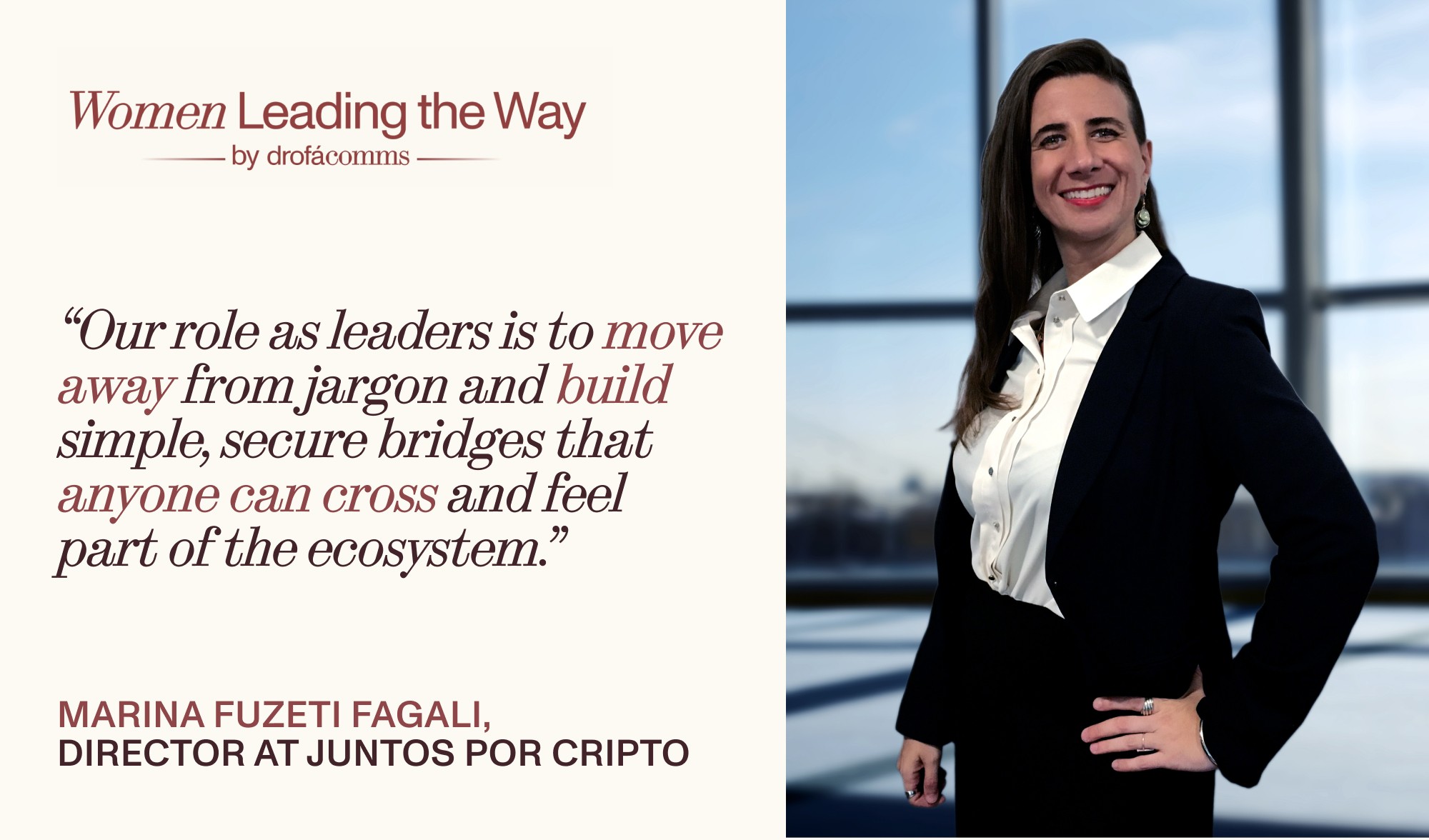
“Leadership means taking up space without waiting for permission. It also means opening paths even when there are no role models to follow.”
That principle is visible in her work with Juntos por Cripto.
Brazilian regulation is entering a decisive period, with debates involving stablecoins, asset segregation and Central Bank rules. For Fagali, however, the quality of these frameworks depends on who regulators actually hear from.
“The voice that still most needs to be heard is that of the community: people on the ground who use crypto every day and do not represent a company or institution.”
Companies and associations naturally have more resources to participate in formal policy discussions. Everyday users usually do not. That can leave policymakers with an incomplete picture of how products work in real life and why people use them.
Women face a similar problem when access to those discussions exists in theory but participation remains low in practice.
For Fagali, passive openness is not sufficient.
“Advocacy groups and associations cannot simply open doors passively; they need to build active bridges.”
She proposes concrete measures: fewer all-male panels, more government-relations training for women executives, stronger support networks and a deliberate effort to bring women into regulatory discussions as technical leaders rather than symbolic participants.
7. Ivana Rocha: Mature Technology Also Means Asking What the System Was Built On
Ivana Rocha brings a somewhat different perspective to this discussion.
Her current work extends outside crypto itself. Rocha is an IBM Technology Leader and founder of iVA, an AI mental health platform focused on women. Yet the questions she raises around data, governance and representation apply directly to the wider digital economy that blockchain is growing into.
Her career did not begin in engineering. Rocha built her background in marketing before moving deeper into technology, eventually working with highly technical software products. Instead of treating that earlier career as baggage she had to overcome, she found that product marketing had trained her to sit between technology, market needs and customer behaviour.
“You have to understand the technology, the market, the customer, and the problem the customer is actually trying to solve. You have to be able to translate between all of them.”
That combination later fed into iVA.
The project grew from Rocha’s own experience and from watching women in her family deal with difficult mental-health circumstances. She began investigating the relationship between mental health, biology, hormones, personal experiences and environment, using technology and AI to organise information and identify questions she had not previously known to ask.
“Technology is what I know now. Why wouldn't I use it to work on this problem?”
For Rocha, however, applying AI to a sensitive field means governance cannot be postponed until the product is already in use. Data provenance, lineage, security, privacy, explainability, testing and human oversight all have to be considered early.
Rocha sees technology as a way to address some inherited gaps.
“Responsible AI is also an opportunity to use technology to address some of the gaps we inherited from the systems that came before it.”
That argument is relevant well outside health technology. Blockchain, tokenisation and AI are often discussed as separate markets, yet they share the same basic governance problem:. It includes technical systems that encode assumptions about their users, their data and the people designing them.
Few people working in Web3 today trained specifically for the roles they now hold. The sector has been built by people moving from finance, law, public policy, engineering, journalism, marketing and countless other disciplines. Its next phase will probably require even more of that cross-pollination.
Conclusion: Maturity Is What Happens After the Hype
Taken together, these seven conversations describe a market dealing with a different set of questions than it did a few years ago.
Melanie Steiner sees adoption accelerating when users no longer need to think about the technology underneath a product. Solange Gueiros points to the infrastructure, data and technical education required to make those products dependable. Heloiza Canassa shows why communication determines whether people can understand and trust what they are being offered.
Julia Rosin and Anna Lucia Berardinelli Castello Branco approach the same question from regulation: markets need standards, institutional cooperation and legal certainty if they are expected to handle more capital and more users. Marina Fuzeti Fagali adds that regulation and product development cannot represent the market properly if the community itself remains outside the room. Ivana Rocha takes the argument one layer deeper by asking what data, assumptions and human experiences technology is built on in the first place.
Their views also complicate the usual discussion about women in Web3.
Women are already leading associations, working with regulators, teaching developers, building products, directing communications and representing major global companies in Brazil. The remaining problem is uneven access. Technical teams, corporate decision-making positions and many policy environments still do not reflect the same level of representation visible among some of the sector’s public leaders.
Fixing that requires investing in technical education, creating routes into senior roles, putting experts in front of decision-makers, making promotion criteria understandable and giving people the confidence and authority to speak about the subjects they know.
Therefore, Brazil’s next stage of Web3 development will be shaped by two things at once: whether its technology can disappear into products people genuinely need, and whether the institutions growing around that technology can earn enough trust to last.
That is also the reason Women Leading the Way exists. Expertise already exists in the market. The task is to make sure more of it is visible, heard and present in the discussions deciding what the next version of finance and technology will look like.
Acknowledgement: the Drofa Comms team is thankful to Melanie Steiner, Solange Gueiros, Anna Lucia Berardinelli Castello Branco, Marina Fuzeti Fagali, Julia Rosin, Heloiza Canassa and Ivana Rocha for contributing their perspectives to this Women Leading the Way article.
London office
Rise, created by Barclays, 41 Luke St, London EC2A 4DP
Nicosia office
2043, Nikokreontos 29, office 202
DP FINANCE COMM LTD (#13523955) Registered Address: N1 7GU, 20-22 Wenlock Road, London, United Kingdom For Operations In The UK
AGAFIYA CONSULTING LTD (#HE 380737) Registered Address: 2043, Nikokreontos 29, Flat 202, Strovolos, Cyprus For Operations In The EU, LATAM, United Stated Of America And Provision Of Services Worldwide
Drofa © 2024
London office
Rise, created by Barclays, 41 Luke St, London EC2A 4DP
Nicosia office
2043, Nikokreontos 29, office 202
DP FINANCE COMM LTD (#13523955) Registered Address: N1 7GU, 20-22 Wenlock Road, London, United Kingdom For Operations In The UK
AGAFIYA CONSULTING LTD (#HE 380737) Registered Address: 2043, Nikokreontos 29, Flat 202, Strovolos, Cyprus For Operations In The EU, LATAM, United Stated Of America And Provision Of Services Worldwide
Drofa © 2024
