NEWS
NEWS
Daria Chernozub of Dash on Blockchain Adoption in Southeast Asia
Daria Chernozub of Dash on Blockchain Adoption in Southeast Asia

As Dash marks its 12th anniversary, the blockchain project remains one of the industry's longest-running networks. It is an uncommon achievement in a sector where many projects disappear within a few years.
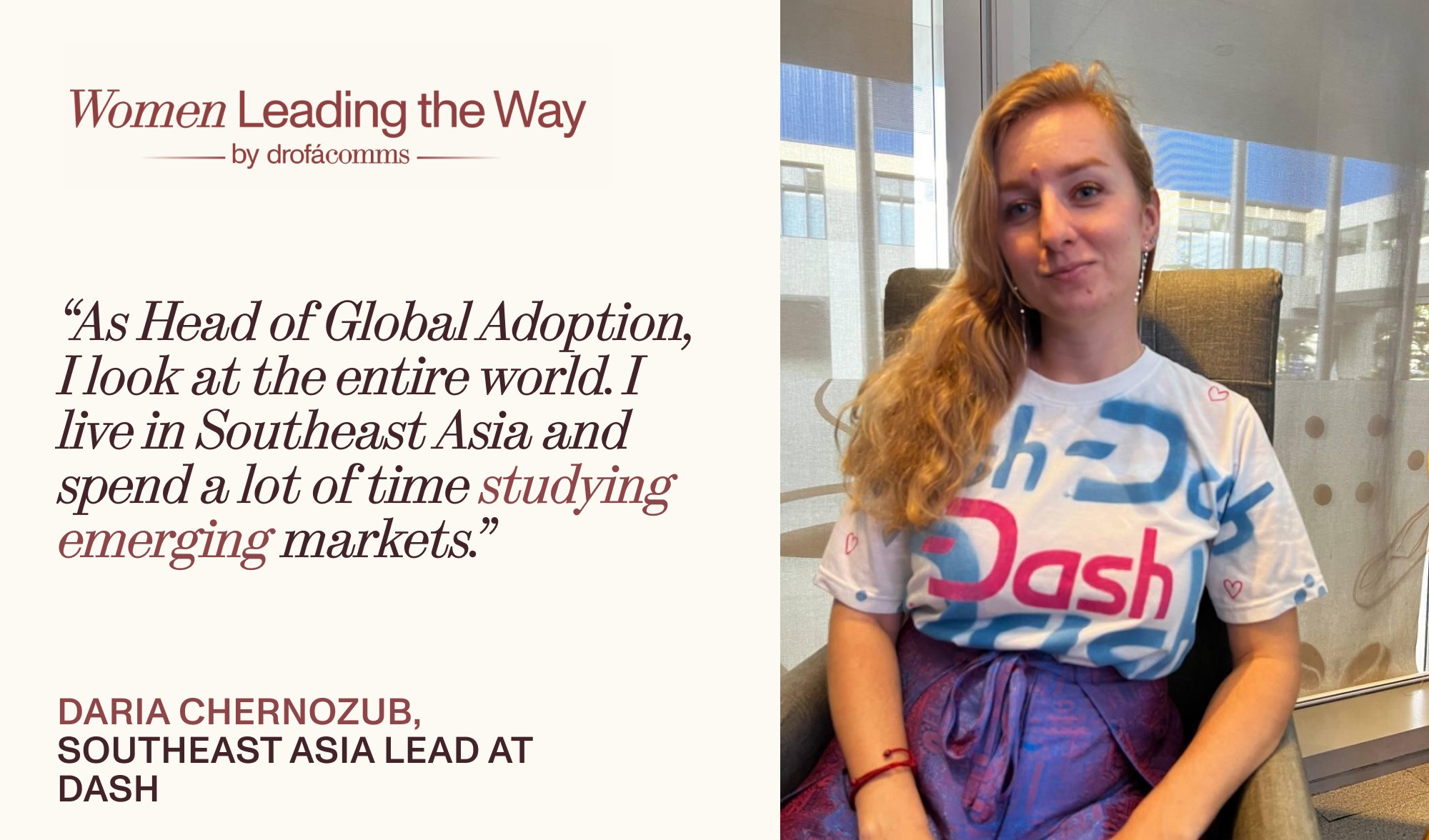
According to Daria Chernozub, Head of Global Adoption at Dash, the project's resilience comes from a community that has stayed committed to decentralisation for over a decade. As one of the few women leading global adoption strategy in the blockchain industry, Chernozub also argues that long-term growth depends as much on collaboration as on innovation.
Any blockchain project’s longevity, she says, starts with the people behind it. In their case, many contributors have remained involved with the project for eight, ten or even twelve years, seeing it not simply as a business or investment but as a reflection of principles they genuinely believe in.
"When people benefit from a system, they care about maintaining and improving it. That creates a very different dynamic from traditional corporate structures," she says during an interview for Women Leading the Way project at the Philippine Blockchain Week 2026.
Driving Blockchain Adoption in Emerging Markets
Dash's anniversary comes at a time when blockchain adoption is becoming global. According to statistics, the Asia-Pacific region has become the world's fastest-growing crypto market, with on-chain transaction volume rising 69% year over year to $2.36 trillion. Vietnam, Indonesia, Thailand and the Philippines continue to rank among the world's leading markets for grassroots crypto adoption.
Given this, the company expands beyond its core blockchain infrastructure, opening up technologies. After spending more than a decade building a well-functioning network, the company is now focused on making that infrastructure available to builders who want to create new applications and services.
Global adoption, however, requires looking well beyond the regulatory debates dominating headlines in Washington and Brussels. Chernozub says emerging markets deserve attention as governments, universities, developer communities and payment ecosystems mature on their own terms instead of simply copying Western models.
In her view, regulation is only one part of the equation. A country's blockchain potential also depends on educational institutions and public attitudes toward innovation and privacy. It is the combination of these factors, rather than legislation alone, that ultimately determines whether new technologies gain traction.
Indeed, education leaves a lot to be desired, as global financial literacy remains critically low. Even in the USA, the average US adult correctly answers only 49% of personal finance questions, not to mention the Asian regions, where people remain traditionally unbanked.
Why Collaboration Matters
These factors, altogether, also shape how the company approaches blockchain itself, as Chernozub compares blockchain to the internet's underlying protocols. They build infrastructure that most users never notice directly but rely on every day through applications built on top of it.
She believes the industry's next phase will be driven by developers creating practical tools rather than by blockchain networks competing for attention. And that matches exactly with the industry trends. Reports show that the ecosystem is becoming more builder-driven and utility-focused: 1 in 3 crypto developers work on multiple chains, and established developers accounted for 70% of code commits.
Chernozub also argues that leadership styles matter when building technology ecosystems. Speaking from her own experience, she says she has always favoured partnerships over rivalry and believes cooperation is particularly important for projects that rely on decentralised communities rather than large corporate budgets.
"I would risk generalising here in an unpopular way: men often fight with each other for various reasons, as opposed to most women, who prefer to collaborate," she says, while acknowledging that this is her personal view.
"My approach is different. I believe in partnerships, relationships and cooperation. We build stronger ecosystems when people work together rather than constantly compete against one another."
Building Connections Across Borders
Despite geopolitical fragmentation, Chernozub remains optimistic about blockchain adoption because the underlying need it serves continues to grow. As someone who lives and works across multiple countries, she sees digital infrastructure as an increasingly essential way for people to stay connected across borders.
"I am a digital nomad. My family lives in one country, my friends live in others, and my work takes me across multiple regions. Technology helps us maintain those connections."
For Chernozub, blockchain's long-term significance lies exactly in this ability to help people exchange value and build relationships regardless of geography — a need she believes will only become more important in the years ahead.
As Dash marks its 12th anniversary, the blockchain project remains one of the industry's longest-running networks. It is an uncommon achievement in a sector where many projects disappear within a few years.
According to Daria Chernozub, Head of Global Adoption at Dash, the project's resilience comes from a community that has stayed committed to decentralisation for over a decade. As one of the few women leading global adoption strategy in the blockchain industry, Chernozub also argues that long-term growth depends as much on collaboration as on innovation.
Any blockchain project’s longevity, she says, starts with the people behind it. In their case, many contributors have remained involved with the project for eight, ten or even twelve years, seeing it not simply as a business or investment but as a reflection of principles they genuinely believe in.
"When people benefit from a system, they care about maintaining and improving it. That creates a very different dynamic from traditional corporate structures," she says during an interview for Women Leading the Way project at the Philippine Blockchain Week 2026.
Driving Blockchain Adoption in Emerging Markets
Dash's anniversary comes at a time when blockchain adoption is becoming global. According to statistics, the Asia-Pacific region has become the world's fastest-growing crypto market, with on-chain transaction volume rising 69% year over year to $2.36 trillion. Vietnam, Indonesia, Thailand and the Philippines continue to rank among the world's leading markets for grassroots crypto adoption.
Given this, the company expands beyond its core blockchain infrastructure, opening up technologies. After spending more than a decade building a well-functioning network, the company is now focused on making that infrastructure available to builders who want to create new applications and services.
Global adoption, however, requires looking well beyond the regulatory debates dominating headlines in Washington and Brussels. Chernozub says emerging markets deserve attention as governments, universities, developer communities and payment ecosystems mature on their own terms instead of simply copying Western models.
In her view, regulation is only one part of the equation. A country's blockchain potential also depends on educational institutions and public attitudes toward innovation and privacy. It is the combination of these factors, rather than legislation alone, that ultimately determines whether new technologies gain traction.
Indeed, education leaves a lot to be desired, as global financial literacy remains critically low. Even in the USA, the average US adult correctly answers only 49% of personal finance questions, not to mention the Asian regions, where people remain traditionally unbanked.
Why Collaboration Matters
These factors, altogether, also shape how the company approaches blockchain itself, as Chernozub compares blockchain to the internet's underlying protocols. They build infrastructure that most users never notice directly but rely on every day through applications built on top of it.
She believes the industry's next phase will be driven by developers creating practical tools rather than by blockchain networks competing for attention. And that matches exactly with the industry trends. Reports show that the ecosystem is becoming more builder-driven and utility-focused: 1 in 3 crypto developers work on multiple chains, and established developers accounted for 70% of code commits.
Chernozub also argues that leadership styles matter when building technology ecosystems. Speaking from her own experience, she says she has always favoured partnerships over rivalry and believes cooperation is particularly important for projects that rely on decentralised communities rather than large corporate budgets.
"I would risk generalising here in an unpopular way: men often fight with each other for various reasons, as opposed to most women, who prefer to collaborate," she says, while acknowledging that this is her personal view.
"My approach is different. I believe in partnerships, relationships and cooperation. We build stronger ecosystems when people work together rather than constantly compete against one another."
Building Connections Across Borders
Despite geopolitical fragmentation, Chernozub remains optimistic about blockchain adoption because the underlying need it serves continues to grow. As someone who lives and works across multiple countries, she sees digital infrastructure as an increasingly essential way for people to stay connected across borders.
"I am a digital nomad. My family lives in one country, my friends live in others, and my work takes me across multiple regions. Technology helps us maintain those connections."
For Chernozub, blockchain's long-term significance lies exactly in this ability to help people exchange value and build relationships regardless of geography — a need she believes will only become more important in the years ahead.
London office
Rise, created by Barclays, 41 Luke St, London EC2A 4DP
Nicosia office
2043, Nikokreontos 29, office 202
DP FINANCE COMM LTD (#13523955) Registered Address: N1 7GU, 20-22 Wenlock Road, London, United Kingdom For Operations In The UK
AGAFIYA CONSULTING LTD (#HE 380737) Registered Address: 2043, Nikokreontos 29, Flat 202, Strovolos, Cyprus For Operations In The EU, LATAM, United Stated Of America And Provision Of Services Worldwide
Drofa © 2024
London office
Rise, created by Barclays, 41 Luke St, London EC2A 4DP
Nicosia office
2043, Nikokreontos 29, office 202
DP FINANCE COMM LTD (#13523955) Registered Address: N1 7GU, 20-22 Wenlock Road, London, United Kingdom For Operations In The UK
AGAFIYA CONSULTING LTD (#HE 380737) Registered Address: 2043, Nikokreontos 29, Flat 202, Strovolos, Cyprus For Operations In The EU, LATAM, United Stated Of America And Provision Of Services Worldwide
Drofa © 2024
