NEWS
NEWS
The New Face of Web3: Women Leading Blockchain Innovation in the Philippines
The New Face of Web3: Women Leading Blockchain Innovation in the Philippines

Philippine Blockchain Week 2026 brought thousands of founders, investors and policymakers to the SMX Convention Centre in Manila between 19 and 21 June. Drofa Comms has also participated as a General Media Sponsor through its Women Leading the Way initiative.
Throughout the conference, Content Manager, Vladimir Rozhankovsky, interviewed founders and ecosystem builders to understand how they see the industry's next stage of development. Surprisingly, the most remarkable conversations at the event weren't about token prices or funding rounds. They were about women who are often left out of financial systems, and who are now rebuilding them.
Two Women, One Changing Industry
Among those leading that conversation were Christine Lim, Global Business Development Director at Coins.ph, and Amira Alawi, Global Marketing Director at Coins.ph. Working at one of the Philippines' largest digital finance platforms, both women exemplify this broader shift taking place across Web3. It's a movement we regularly cover through our Women Leading the Way initiative.
Christine Lim and Amira Alawi are living proof that the financial industry’s gender balance has changed faster than most of us realise. Women still make up only around 7–13% of Web3 founders, though they account for roughly 27% of the workforce at leading Web3 startups, according to a 2022–2023 Boston Consulting Group study.
As the speakers say, women are no longer limited to marketing and community roles in Web3. Each year, we see that they're increasingly leading strategy, partnerships, and product development. The conversation has shifted from representation to leadership.
The Underestimated Region
For many outside the region, blockchain innovation is still associated with the United States or Europe. Yet Southeast Asia continues to produce some of the most practical examples of real-world adoption. According to research, the Central and South Asia and Oceania (CSAO) region, which includes Southeast Asia, is leading the world in blockchain adoption. The Philippines, Indonesia, Vietnam and Thailand perform well in all sub-indexes.
So, following the trend, in the Philippines, where cash dominated everyday transactions until recently, digital wallets have become part of daily life. Locals note that stablecoins are making cross-border payments and remittances easier for millions of Filipino workers supporting their families back home.
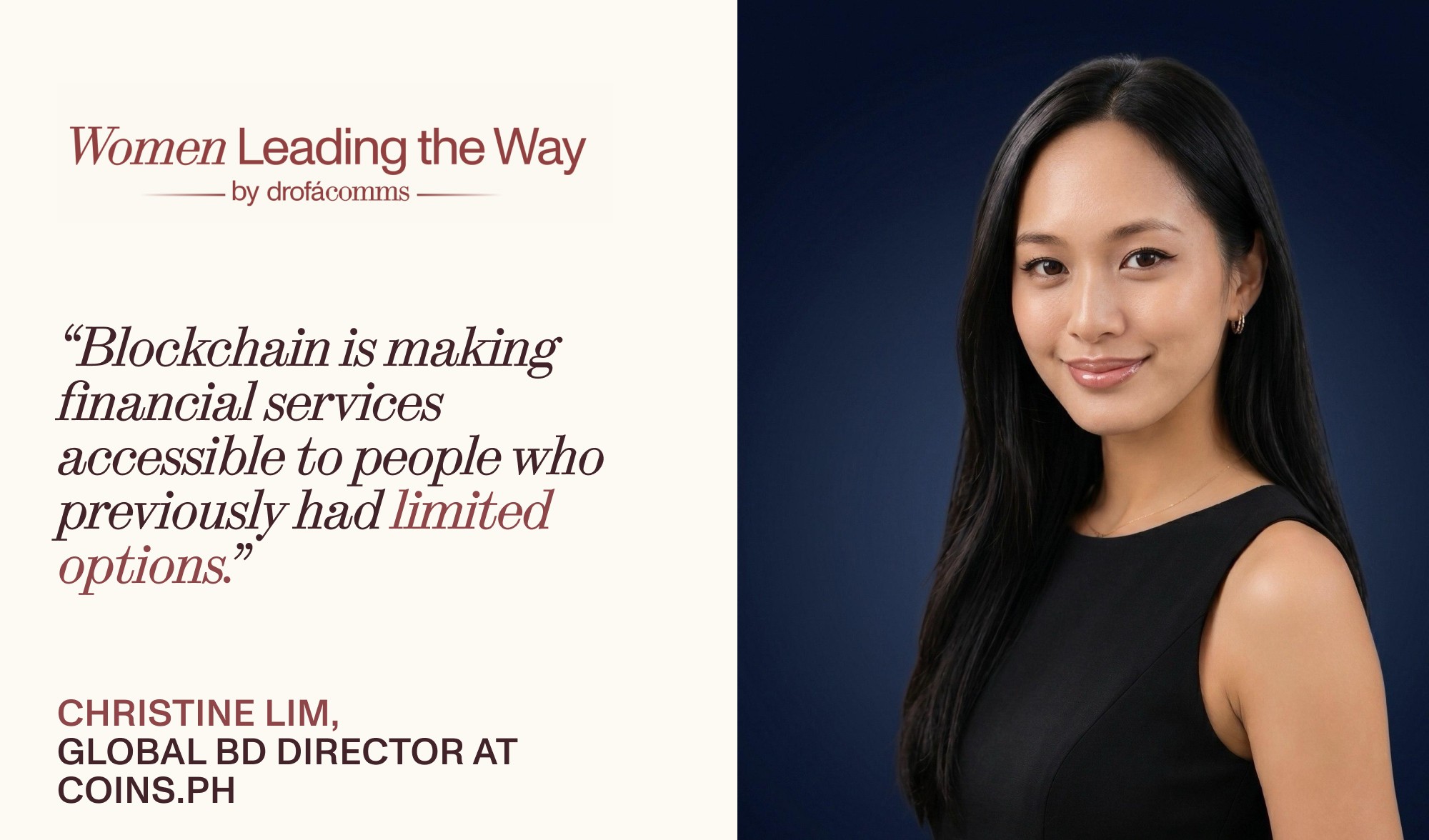
As Christine Lim pointed out, the real value of blockchain is wider access. "Blockchain isn't simply making payments faster — it's making financial services accessible to people who previously had limited options."
That focus on accessibility also changes how products are built. Both speakers argued that successful fintech companies are no longer competing through technology alone. Instead, they win users by making complex financial tools feel almost invisible.
"The real challenge is making something complex feel simple," Lim said. "People don't need to think about blockchain every time they open an app."
Building Trust by Education
Both interviewed women also highlighted that accessibility has as much to do with trust and simplicity as with the technology itself. In a country where millions remain underbanked, digital finance has to fit naturally into everyday life. Asking people to change their behaviour overnight has already proved to be an inefficient strategy.
Education, however, remains just as important as product design. Both executives stressed that technology alone does not change financial habits. Building confidence, especially among first-time users and communities outside major cities, is what ultimately drives adoption.
"Education creates confidence, and confidence drives adoption," Alawi said.
So far, women also remain less educated than men. And the education gap directly affects their financial behaviour. The IMF notes that gender gaps in digital financial inclusion are measured, in particular, by the proportion of women who graduate from high school and the proportion of women among STEM graduates.
Where the Next Generation of Women in Web3 Moves to
Perhaps most importantly for Women Leading the Way, both executives see the industry's own leadership changing alongside its technology. They believe the conversation has moved beyond simply increasing representation. More women are now leading strategy, engineering, cybersecurity, partnerships and executive decision-making, helping shape products through a wider range of perspectives.
"Better representation produces better products because more perspectives are involved in solving real-world problems," Amira Alawi said.
She also offered advice to women considering careers in blockchain and fintech: don't wait until you feel completely ready. In an industry evolving as quickly as Web3, everyone is learning. Curiosity, diverse perspectives and the confidence to start, she believes, matter far more than having every answer from day one.
If financial inclusion is one of blockchain's biggest promises, conversations like this suggest that its future will be shaped not only by new technologies, but also by the people making those technologies more accessible and, ultimately, more intuitive.
Philippine Blockchain Week 2026 brought thousands of founders, investors and policymakers to the SMX Convention Centre in Manila between 19 and 21 June. Drofa Comms has also participated as a General Media Sponsor through its Women Leading the Way initiative.
Throughout the conference, Content Manager, Vladimir Rozhankovsky, interviewed founders and ecosystem builders to understand how they see the industry's next stage of development. Surprisingly, the most remarkable conversations at the event weren't about token prices or funding rounds. They were about women who are often left out of financial systems, and who are now rebuilding them.
Two Women, One Changing Industry
Among those leading that conversation were Christine Lim, Global Business Development Director at Coins.ph, and Amira Alawi, Global Marketing Director at Coins.ph. Working at one of the Philippines' largest digital finance platforms, both women exemplify this broader shift taking place across Web3. It's a movement we regularly cover through our Women Leading the Way initiative.
Christine Lim and Amira Alawi are living proof that the financial industry’s gender balance has changed faster than most of us realise. Women still make up only around 7–13% of Web3 founders, though they account for roughly 27% of the workforce at leading Web3 startups, according to a 2022–2023 Boston Consulting Group study.
As the speakers say, women are no longer limited to marketing and community roles in Web3. Each year, we see that they're increasingly leading strategy, partnerships, and product development. The conversation has shifted from representation to leadership.
The Underestimated Region
For many outside the region, blockchain innovation is still associated with the United States or Europe. Yet Southeast Asia continues to produce some of the most practical examples of real-world adoption. According to research, the Central and South Asia and Oceania (CSAO) region, which includes Southeast Asia, is leading the world in blockchain adoption. The Philippines, Indonesia, Vietnam and Thailand perform well in all sub-indexes.
So, following the trend, in the Philippines, where cash dominated everyday transactions until recently, digital wallets have become part of daily life. Locals note that stablecoins are making cross-border payments and remittances easier for millions of Filipino workers supporting their families back home.
As Christine Lim pointed out, the real value of blockchain is wider access. "Blockchain isn't simply making payments faster — it's making financial services accessible to people who previously had limited options."
That focus on accessibility also changes how products are built. Both speakers argued that successful fintech companies are no longer competing through technology alone. Instead, they win users by making complex financial tools feel almost invisible.
"The real challenge is making something complex feel simple," Lim said. "People don't need to think about blockchain every time they open an app."
Building Trust by Education
Both interviewed women also highlighted that accessibility has as much to do with trust and simplicity as with the technology itself. In a country where millions remain underbanked, digital finance has to fit naturally into everyday life. Asking people to change their behaviour overnight has already proved to be an inefficient strategy.
Education, however, remains just as important as product design. Both executives stressed that technology alone does not change financial habits. Building confidence, especially among first-time users and communities outside major cities, is what ultimately drives adoption.
"Education creates confidence, and confidence drives adoption," Alawi said.
So far, women also remain less educated than men. And the education gap directly affects their financial behaviour. The IMF notes that gender gaps in digital financial inclusion are measured, in particular, by the proportion of women who graduate from high school and the proportion of women among STEM graduates.
Where the Next Generation of Women in Web3 Moves to
Perhaps most importantly for Women Leading the Way, both executives see the industry's own leadership changing alongside its technology. They believe the conversation has moved beyond simply increasing representation. More women are now leading strategy, engineering, cybersecurity, partnerships and executive decision-making, helping shape products through a wider range of perspectives.
"Better representation produces better products because more perspectives are involved in solving real-world problems," Amira Alawi said.
She also offered advice to women considering careers in blockchain and fintech: don't wait until you feel completely ready. In an industry evolving as quickly as Web3, everyone is learning. Curiosity, diverse perspectives and the confidence to start, she believes, matter far more than having every answer from day one.
If financial inclusion is one of blockchain's biggest promises, conversations like this suggest that its future will be shaped not only by new technologies, but also by the people making those technologies more accessible and, ultimately, more intuitive.
London office
Rise, created by Barclays, 41 Luke St, London EC2A 4DP
Nicosia office
2043, Nikokreontos 29, office 202
DP FINANCE COMM LTD (#13523955) Registered Address: N1 7GU, 20-22 Wenlock Road, London, United Kingdom For Operations In The UK
AGAFIYA CONSULTING LTD (#HE 380737) Registered Address: 2043, Nikokreontos 29, Flat 202, Strovolos, Cyprus For Operations In The EU, LATAM, United Stated Of America And Provision Of Services Worldwide
Drofa © 2024
London office
Rise, created by Barclays, 41 Luke St, London EC2A 4DP
Nicosia office
2043, Nikokreontos 29, office 202
DP FINANCE COMM LTD (#13523955) Registered Address: N1 7GU, 20-22 Wenlock Road, London, United Kingdom For Operations In The UK
AGAFIYA CONSULTING LTD (#HE 380737) Registered Address: 2043, Nikokreontos 29, Flat 202, Strovolos, Cyprus For Operations In The EU, LATAM, United Stated Of America And Provision Of Services Worldwide
Drofa © 2024
