Clare Adelgren
EY Interim Global Blockchain Leader
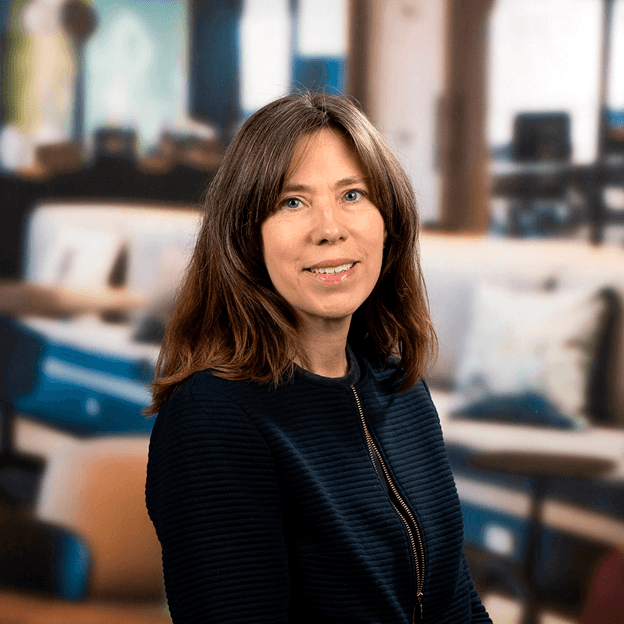
Clare, after two decades at IBM, you moved to Ernst & Young to lead blockchain sales and operations. What brought you into blockchain, and why now?
I’ve always been drawn to technologies that fundamentally change how businesses operate, rather than just incrementally improve them. Blockchain stood out because it challenges long-standing assumptions around trust and transparency, and it has enormous potential to radically change our payments infrastructure.
At IBM, I enjoyed working with global clients on complex transformations across a wide range of technologies; it was a great grounding, and it was always focused on solving for the enterprise needs. At EY, I’m centred on the emerging tech space, and specifically blockchain and the broader ecosystem around it. Our team operates much closer to a start-up — more entrepreneurial — so I can really draw on all my skills.
I moved to EY almost four years ago, and at that time, enterprise blockchain was still experimental, but I recognised it was moving into something real and actionable. The timing felt right, both in terms of the maturity of the technology and adoption, with organisations finally being ready to rethink operating models, instead of just digitising existing ones.
It seems the move to EY gave you a different kind of proximity to where the market is heading. Since you’re in the space now, how, in your view, are women represented in blockchain and emerging tech, and how does that compare to traditional enterprise tech and consulting?
Women are still underrepresented in blockchain, particularly in technical and leadership roles. BCG found that while women are around 27% of the workforce at top Web3 startups, they’re only about 12% in technical roles. That steep drop in technical tracks makes the gap feel more visible than in traditional enterprise tech. Still, I think that visibility can help, because more people recognise there’s a problem to solve.
One difference between emerging tech versus established consulting or enterprise one is that blockchain doesn’t yet have the same structured pipelines or longstanding networks — after all, it’s still a relatively new industry. Even though that creates challenges, it also creates an opportunity, as with fewer legacy paths, we can design more inclusive ones from the start.
I’m also optimistic that representation will improve as digital assets become increasingly important for traditional financial institutions and payments providers. We’ve seen progress in recent years in the representation of women in finance, and that progress will also carry over into the blockchain talent ecosystem.
It's encouraging that you're optimistic about representation improving. At the same time, the space still carries a lot of myths about women in emerging tech. From where you sit, what’s the biggest one, and what’s the reality you see on the inside?
The biggest myth is that there simply aren’t enough women interested or qualified. So the talent is there, but often distributed differently and not always recognised by traditional hiring criteria.
From the inside, what I often see is women who are interested and want to get involved, yet struggle to be seen. In some parts of finance and emerging tech, success has historically been associated with very narrow leadership archetypes — often tied to confidence signalling, risk-taking styles, and informal networks — and women who don’t fit that profile can feel excluded.
At the same time, there is a growing community of women in blockchain, many of whom are leading new businesses, driving adoption, and translating highly technical concepts for buyers into real business outcomes. They can have a tremendous impact in supporting other women joining the community. So the real issue is a lack of visibility, sponsorship, and access to the right opportunities at the right time.
What you’re describing sounds like a visibility gap that compounds over time. But if we want to fix it, what practical steps would you recommend to bring more women into blockchain roles?
First and foremost, stop treating blockchain as a purely technical niche. Many of the most critical roles sit at the intersection of technology, operations, risk, and strategy. So women with strong backgrounds in those areas can move into blockchain roles and excel, even without a traditional “crypto” resume.
Then invest in education — internal training, rotations, and real client exposure. That shouldn’t be limited to engineers, as consultants, sales leaders, and operators can also play key roles in making blockchain beneficial to the business.
Ultimately, sponsorship matters. Pairing learning with advocacy allows women to gain skills while also being actively positioned for stretch roles and leadership opportunities.
Those actionable steps make the problem feel quite solvable. Zooming out, since you’ve worked across Europe, Japan, and the US, did you notice differences in how women are represented and supported in emerging tech? Where is the pipeline strongest, and where is it still weakest, and why?
Well, experience has taught me that there’s very rarely a single “global truth,” because systems, culture, and moments where progress tends to stall differ by region. You can see some of those differences when you look at the various stages of career growth.
The pipeline is strongest where education, early-career access, and institutional support align. For instance, in Europe, the focus has been on ensuring women are represented well early in STEM education programs. That focus has already shown good results through research and early innovation (about 35% of STEM researchers are women).
On the other side of the planet, in the US, women hold around 30% of STEM jobs. So it’s in the same ballpark as Europe’s figure, yet the challenge is persistent attrition in the early years. Even with that, the US does somewhat better than other regions on the visibility of women in senior technology leadership and founder roles, even if overall representation remains low. There, if you can get past the early barriers, you have a great chance of achieving success.
So I’d say these differences are rarely due to a lack of talent or interest, if at all. They mostly come down to systems and culture, so each region loses women at different points along the way.
Exactly, it’s rarely about talent. By the way, speaking of your approach to hiring, what signals leadership potential — especially in women who may not self-promote?
Apart from volume, I look for patterns: who consistently connects dots, who anticipates issues before they escalate, and who creates clarity for others in ambiguous situations.
The thing is that many women demonstrate through impact rather than amplification. So, as a leader, it’s my responsibility to notice and make sure their efforts are translated into opportunities — not overlooked just because they don’t fit a traditional mould.
Thank you, that’s a very candid lens from the inside! Looking ahead, if you could give one piece of advice to a woman starting a career in blockchain and tech in 2026, what would it be, and why?
Don’t wait to feel “ready.” This space is evolving too quickly for anyone to have perfect credentials. Focus on learning velocity (not mastery) and put yourself in rooms where the problems are not only solved, but also defined.
In the end, blockchain rewards curiosity, resilience, and the ability to bridge worlds. If you can combine technical understanding with business judgment and confidence in your perspective, you’ll be far more prepared than you think.
