NEWS
NEWS
Women in Fintech Leadership: Why Promotions Don’t Turn Into Top Roles in 2026
Women in Fintech Leadership: Why Promotions Don’t Turn Into Top Roles in 2026

In 2026, women’s leadership data in fintech plainly shows that women are being promoted at scale. Revolut’s recent report states that in Q2 2025, women had a higher progression success rate than men (90.6% vs. 81.5%) and accounted for 37% of all progressions.
Still, an unpleasant reality is that top roles don’t reflect the same tendency. EY notes that in the UK, women hold only around 10% of fintech board seats and represent less than 20% of company executives, which makes it obvious — women can win promotions, but the same isn’t true for roles that hold power.
So, as part of Women Leading the Way, Drofa Comms asked women leaders from fintech and finance to answer the question that naturally follows: if promotions can go right, why is the road to leadership still narrow?
Rules in Fintech That Limit Women’s Power
To answer why promotions can go right while leadership outcomes stay stuck, it’s worth kicking off with what really decides who gets “counted” as leadership material in the first place. In many fintech teams, the blockers are well-established rules: who gets trusted early, who gets the credit when goals are attained, and whose name comes up when leaders talk about “readiness.”
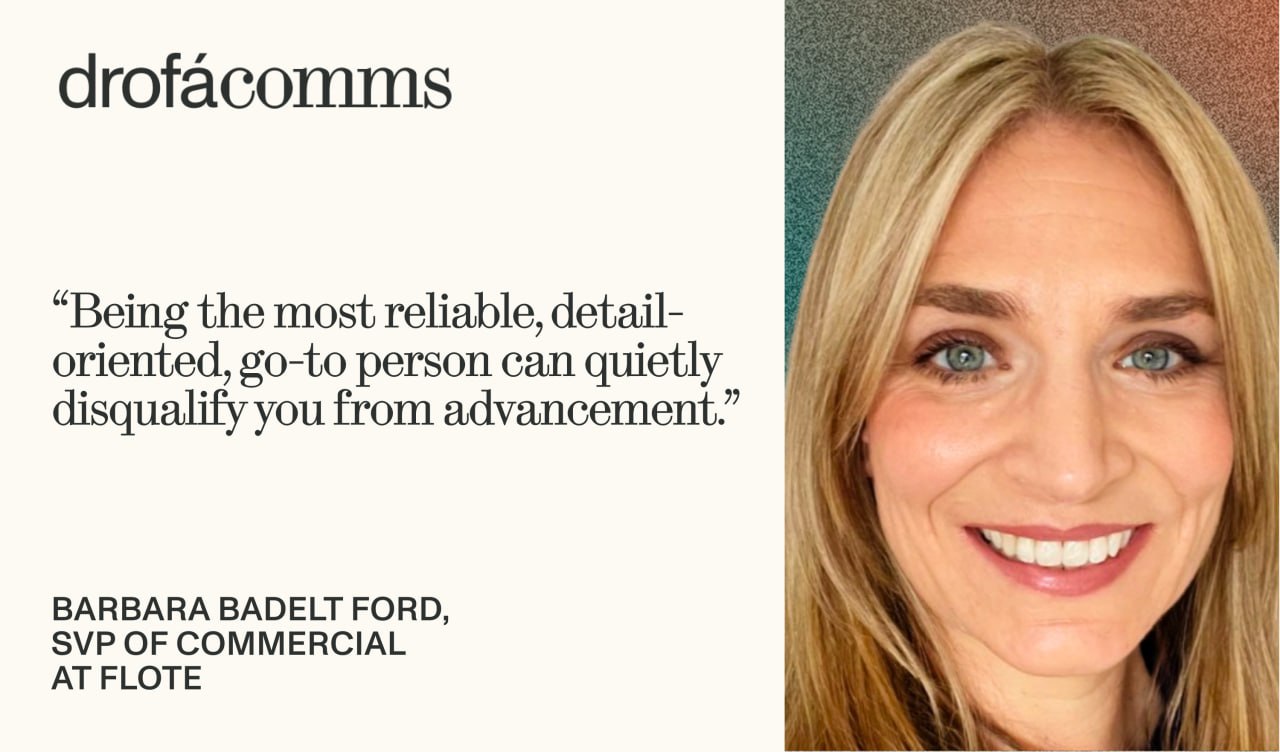
In practice, these rules play out in many different ways — one of the most common is the “workhorse” label. In a note shared with Drofa Comms, Barbara Badelt Ford, SVP of Commercial at Flote, describes it without sugarcoating: “being the most reliable, detail-oriented, go-to person can quietly disqualify you from advancement.”
Simply put, when you become essential in a particular role, the business protects itself by keeping you in it — so there, you’re valued for reliability, and not considered for a bigger mandate.
Leaving aside the workhorse label, Barbara also outlines how senior promotions are typically made: “Promotions — especially at senior levels — are driven by perceived scope, leverage, and impact, not volume of work or perfection.” So even if you work tirelessly, you can still end up less visible than someone who has already launched a major project or resolved a high-stakes issue.
Last but not least, many women get into a networking pit: they have less time for the after-hours relationship building that often opens doors.
As Katharine Wooller, Chief Strategist — Financial Services at Softcat, puts it: “Men tend to have a better and deeper network, as women with caregiving responsibilities don't have the same capacity for networking outside working hours.” In other words, that extra time is what gives men more chances to build ties and gain access to senior circles.
Over time, these rules shape who gets seen as “senior-ready” and who doesn’t. But what happens when a leadership role finally opens?
How Senior Roles Get Pre-Filled
Even when a leadership position opens up, there’s another trap — the quiet pre-work that happens before a senior seat is ever posted.
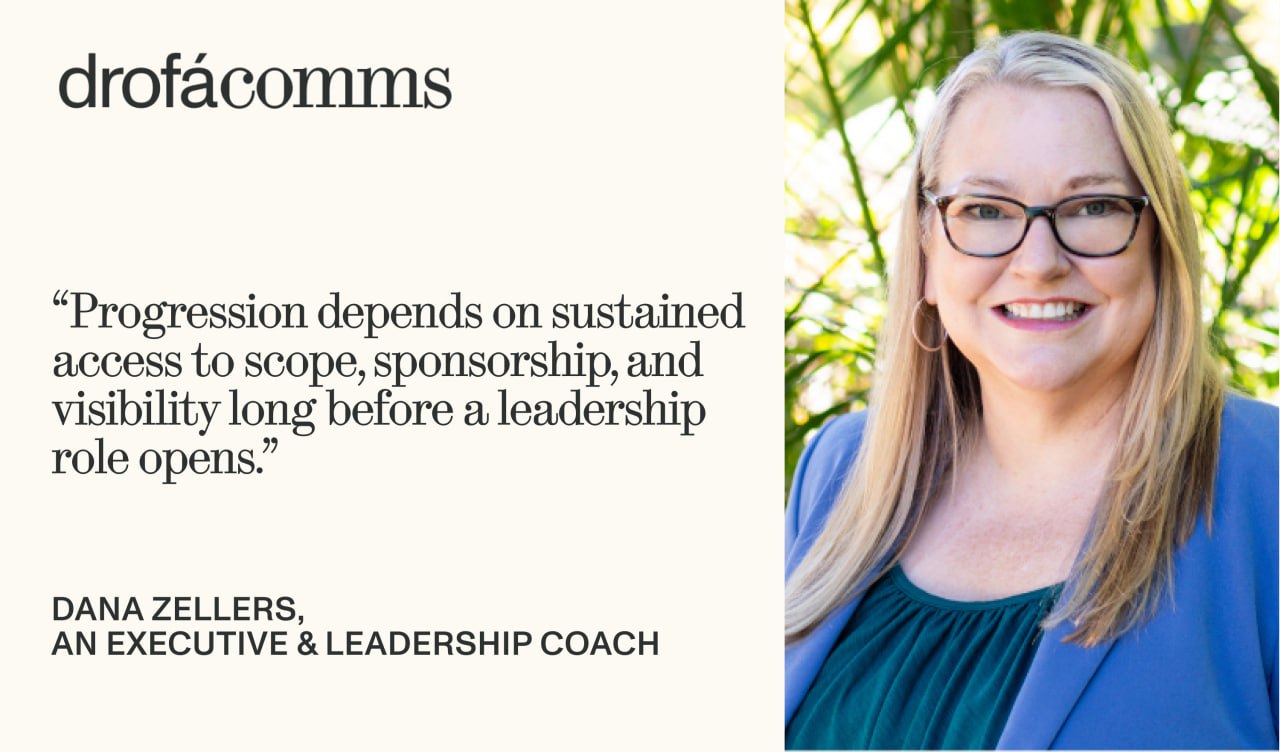
As Dana Zellers, a seasoned Executive & Leadership coach and the founder of the eponymous company, says, “Promotion is a moment in time. Progression depends on sustained access to scope, sponsorship, and visibility long before a leadership role opens.”
To put it bluntly, many leadership roles are primarily distributed early, with the likely candidate appearing in advance — during planning talks, crisis meetings, and budget reviews — when leaders ask who can carry risk, who can speak for the business, and who already has trust across teams. So, by the time a formal process begins, a shortlist is often already in place.
Taken together, all of this explains why promotions can be a no-brainer for women in fintech, while access to leadership roles can still be hard. Yet, this isn’t inevitable.
The remedy starts with making leadership criteria explicit in your organisation, then backing it with practical mechanisms, like sponsorship that opens doors or mentoring that leads to real introductions.
Fixes Fintech Leaders Can Implement This Year
In essence, fixing this problem means starting by defining what leadership looks like in your organisation in plain terms. In fact, when the criteria are vague, decisions slide toward familiar people. Dana Zellers puts it this way: “Make progression criteria explicit rather than assumed.”
Then change what leaders praise and who gets the commercial assignments.
As Barbara Badelt Ford emphasises: “Leaders can unlock promotion pathways for women stuck in the workhorse pattern by changing what they reward and how they allocate opportunity. They should actively identify and redistribute invisible labour, and deliberately rotate high-performing women into visible, high-leverage roles with strategic or commercial exposure.”
Ultimately, provide real support: mentoring programmes that build senior-ready skills, strong return-to-work backing after maternity leave, and sponsorship that helps women gain executive visibility. Sponsorship, after all, is triggered by the ask, so women should be persistent about requesting advocacy in succession discussions.
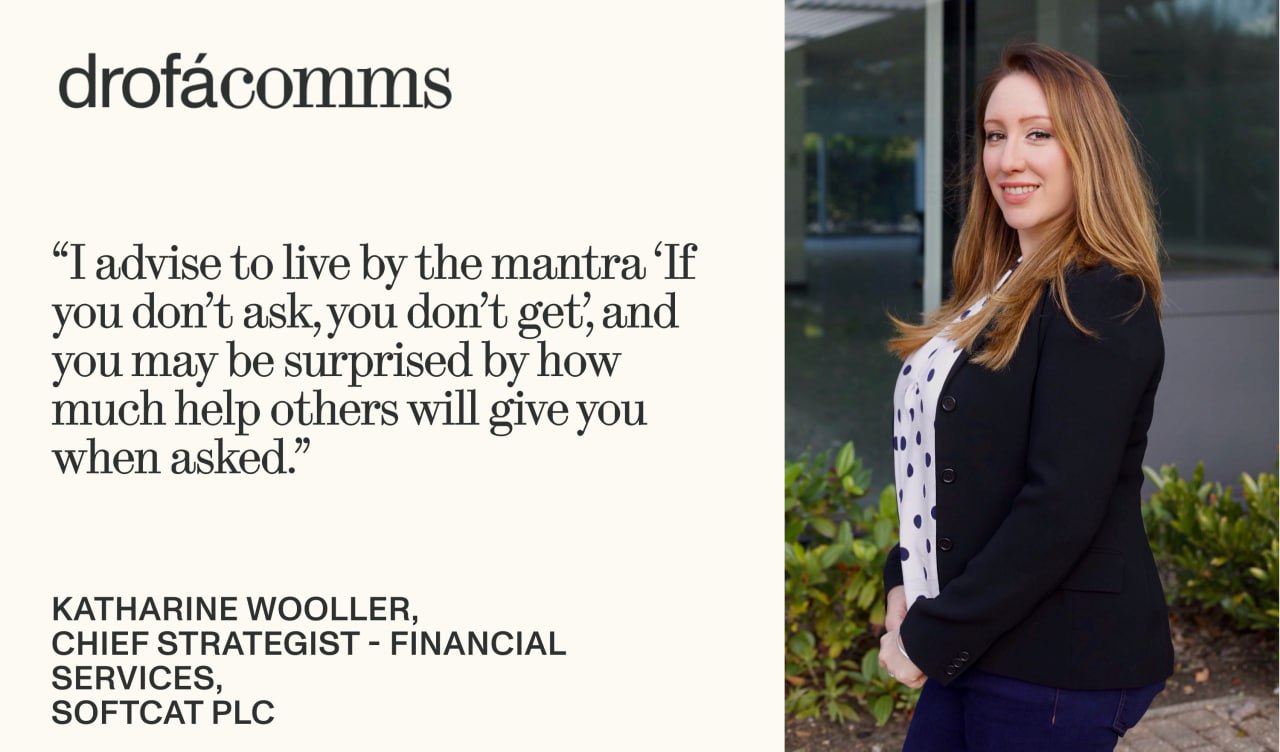
Katharine Wooller makes the same point: “I advise to live by the mantra ‘If you don’t ask, you don’t get’, and you may be surprised by how much help others will give you when asked,” she says.
Conclusion
None of this diminishes the value of promotions — they still matter. They show women are performing, meeting the bar, and getting recognised in their roles.
Nevertheless, the reason the road to leadership stays narrow is that senior roles are rarely awarded at the point of promotion. And the fix should certainly not be another round of headline pledges. It should be managing access upstream:
define leadership criteria in concrete terms;
redistribute invisible labour;
require sponsorship to be measurable in actions.
At Drofa Comms, we see these patches as the driver of the next phase, helping convert promotion wins into decision-making seats. When the fintech industry accepts this reality, women leaders become far more likely to reach the roles they’ve earned.
Acknowledgements: Drofa Comms is thankful to Barbara Badelt Ford, Katharine Wooller, and Dana Zellers for lending their expertise to this Women Leading the Way article.
In 2026, women’s leadership data in fintech plainly shows that women are being promoted at scale. Revolut’s recent report states that in Q2 2025, women had a higher progression success rate than men (90.6% vs. 81.5%) and accounted for 37% of all progressions.
Still, an unpleasant reality is that top roles don’t reflect the same tendency. EY notes that in the UK, women hold only around 10% of fintech board seats and represent less than 20% of company executives, which makes it obvious — women can win promotions, but the same isn’t true for roles that hold power.
So, as part of Women Leading the Way, Drofa Comms asked women leaders from fintech and finance to answer the question that naturally follows: if promotions can go right, why is the road to leadership still narrow?
Rules in Fintech That Limit Women’s Power
To answer why promotions can go right while leadership outcomes stay stuck, it’s worth kicking off with what really decides who gets “counted” as leadership material in the first place. In many fintech teams, the blockers are well-established rules: who gets trusted early, who gets the credit when goals are attained, and whose name comes up when leaders talk about “readiness.”
In practice, these rules play out in many different ways — one of the most common is the “workhorse” label. In a note shared with Drofa Comms, Barbara Badelt Ford, SVP of Commercial at Flote, describes it without sugarcoating: “being the most reliable, detail-oriented, go-to person can quietly disqualify you from advancement.”
Simply put, when you become essential in a particular role, the business protects itself by keeping you in it — so there, you’re valued for reliability, and not considered for a bigger mandate.
Leaving aside the workhorse label, Barbara also outlines how senior promotions are typically made: “Promotions — especially at senior levels — are driven by perceived scope, leverage, and impact, not volume of work or perfection.” So even if you work tirelessly, you can still end up less visible than someone who has already launched a major project or resolved a high-stakes issue.
Last but not least, many women get into a networking pit: they have less time for the after-hours relationship building that often opens doors.
As Katharine Wooller, Chief Strategist — Financial Services at Softcat, puts it: “Men tend to have a better and deeper network, as women with caregiving responsibilities don't have the same capacity for networking outside working hours.” In other words, that extra time is what gives men more chances to build ties and gain access to senior circles.
Over time, these rules shape who gets seen as “senior-ready” and who doesn’t. But what happens when a leadership role finally opens?
How Senior Roles Get Pre-Filled
Even when a leadership position opens up, there’s another trap — the quiet pre-work that happens before a senior seat is ever posted.
As Dana Zellers, a seasoned Executive & Leadership coach and the founder of the eponymous company, says, “Promotion is a moment in time. Progression depends on sustained access to scope, sponsorship, and visibility long before a leadership role opens.”
To put it bluntly, many leadership roles are primarily distributed early, with the likely candidate appearing in advance — during planning talks, crisis meetings, and budget reviews — when leaders ask who can carry risk, who can speak for the business, and who already has trust across teams. So, by the time a formal process begins, a shortlist is often already in place.
Taken together, all of this explains why promotions can be a no-brainer for women in fintech, while access to leadership roles can still be hard. Yet, this isn’t inevitable.
The remedy starts with making leadership criteria explicit in your organisation, then backing it with practical mechanisms, like sponsorship that opens doors or mentoring that leads to real introductions.
Fixes Fintech Leaders Can Implement This Year
In essence, fixing this problem means starting by defining what leadership looks like in your organisation in plain terms. In fact, when the criteria are vague, decisions slide toward familiar people. Dana Zellers puts it this way: “Make progression criteria explicit rather than assumed.”
Then change what leaders praise and who gets the commercial assignments.
As Barbara Badelt Ford emphasises: “Leaders can unlock promotion pathways for women stuck in the workhorse pattern by changing what they reward and how they allocate opportunity. They should actively identify and redistribute invisible labour, and deliberately rotate high-performing women into visible, high-leverage roles with strategic or commercial exposure.”
Ultimately, provide real support: mentoring programmes that build senior-ready skills, strong return-to-work backing after maternity leave, and sponsorship that helps women gain executive visibility. Sponsorship, after all, is triggered by the ask, so women should be persistent about requesting advocacy in succession discussions.
Katharine Wooller makes the same point: “I advise to live by the mantra ‘If you don’t ask, you don’t get’, and you may be surprised by how much help others will give you when asked,” she says.
Conclusion
None of this diminishes the value of promotions — they still matter. They show women are performing, meeting the bar, and getting recognised in their roles.
Nevertheless, the reason the road to leadership stays narrow is that senior roles are rarely awarded at the point of promotion. And the fix should certainly not be another round of headline pledges. It should be managing access upstream:
define leadership criteria in concrete terms;
redistribute invisible labour;
require sponsorship to be measurable in actions.
At Drofa Comms, we see these patches as the driver of the next phase, helping convert promotion wins into decision-making seats. When the fintech industry accepts this reality, women leaders become far more likely to reach the roles they’ve earned.
Acknowledgements: Drofa Comms is thankful to Barbara Badelt Ford, Katharine Wooller, and Dana Zellers for lending their expertise to this Women Leading the Way article.
London office
Rise, created by Barclays, 41 Luke St, London EC2A 4DP
Nicosia office
2043, Nikokreontos 29, office 202
DP FINANCE COMM LTD (#13523955) Registered Address: N1 7GU, 20-22 Wenlock Road, London, United Kingdom For Operations In The UK
AGAFIYA CONSULTING LTD (#HE 380737) Registered Address: 2043, Nikokreontos 29, Flat 202, Strovolos, Cyprus For Operations In The EU, LATAM, United Stated Of America And Provision Of Services Worldwide
Drofa © 2024
London office
Rise, created by Barclays, 41 Luke St, London EC2A 4DP
Nicosia office
2043, Nikokreontos 29, office 202
DP FINANCE COMM LTD (#13523955) Registered Address: N1 7GU, 20-22 Wenlock Road, London, United Kingdom For Operations In The UK
AGAFIYA CONSULTING LTD (#HE 380737) Registered Address: 2043, Nikokreontos 29, Flat 202, Strovolos, Cyprus For Operations In The EU, LATAM, United Stated Of America And Provision Of Services Worldwide
Drofa © 2024
