NEWS
NEWS
Meritocracy in Finance: Why It Is Still Incomplete for Women and What Must Change
Meritocracy in Finance: Why It Is Still Incomplete for Women and What Must Change
The financial industry has long presented itself as a place where merit determines who gets hired, promoted, and given opportunities. Fidelity International calls itself “a true meritocracy” in its investment-management careers material. Credit Suisse's code of conduct has a separate “Meritocracy” page claiming that they genuinely believe in it.
But is meritocracy in finance truly as genuine as the industry likes to believe? A recent WIBF study gives a reason to doubt it. Its four-year ACT programme found that among many women entering financial services, far fewer receive meaningful access to the opportunities, visibility, and support. So women still do not get equal chances to show their skills and prove themselves.
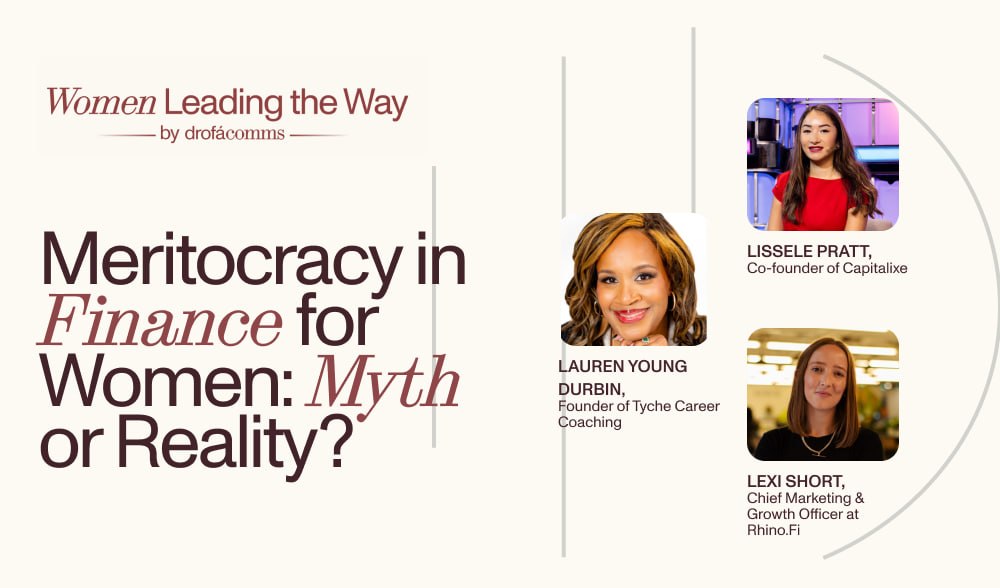
As part of the Women Leading the Way initiative, the Drofa Comms team spoke with senior women professionals about whether meritocracy in finance is still more aspiration than reality. Their answers point out that women are often judged on performance only after they manage to enter the room. Yet, access to that room still hinges on established networks and on who is willing to recommend them.
The Barrier That Keeps the Most Women Out
One of the first things Lauren Young Durbin, Founder of Tyche Career Coaching, noticed when she began coaching women was that qualification was rarely the real issue. In law, healthcare, and finance, many women already had the skills, the experience, and the discipline required to reach success.
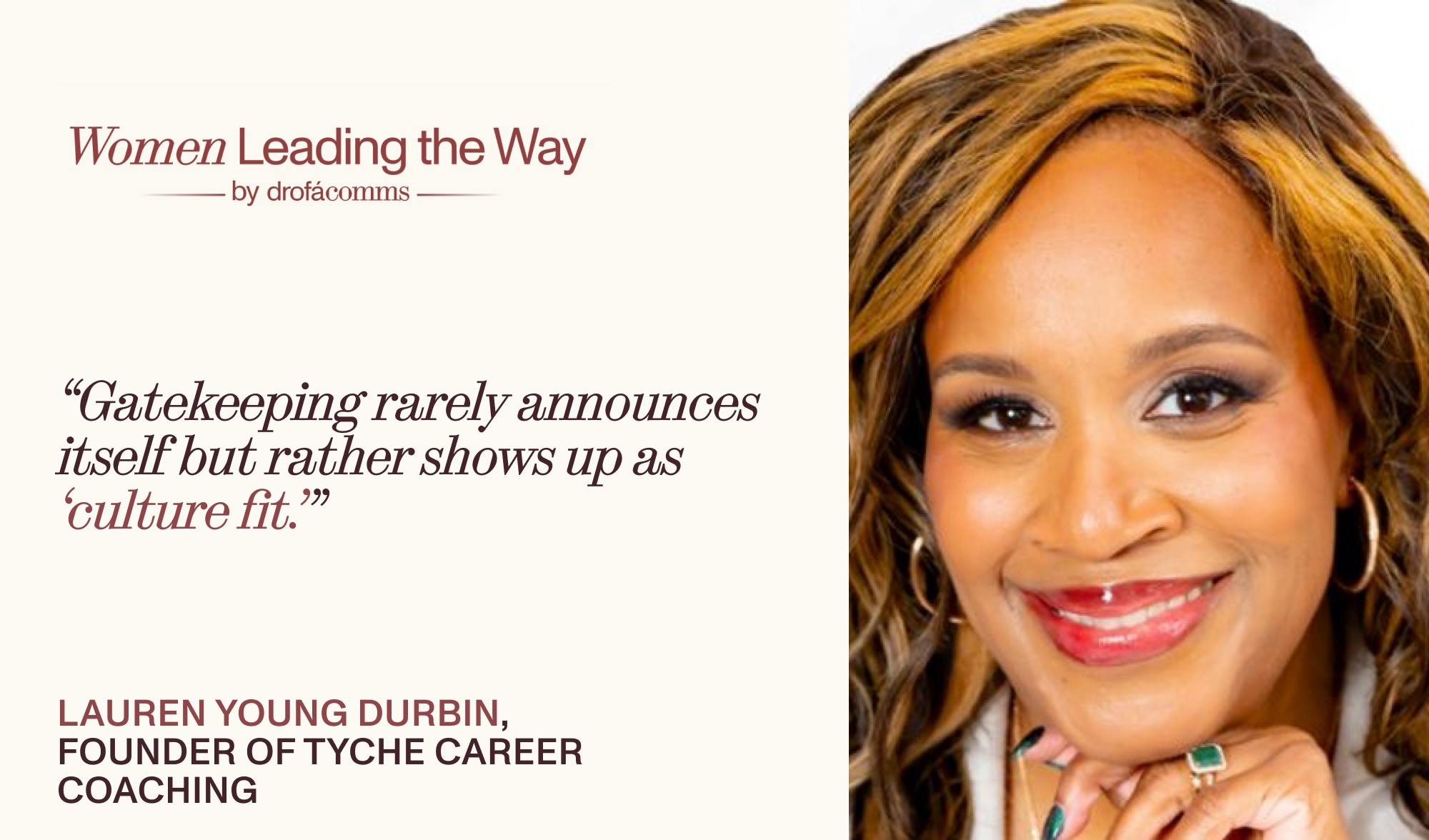
In her view, the bigger problem is how access is distributed. In finance, many roles are still taken by informal recommendations and internal networks. As a result, the people already inside the system often decide who gets seen as a strong candidate in the first place. Lauren describes this as a gatekeeping problem. “It rarely announces itself,” she says. “It shows up as ‘culture fit’ — in hiring processes that run on referrals while passing off as meritocracy.”
We see this as one of the main weaknesses in how the industry talks about meritocracy. A system cannot credibly call itself merit-based when access and endorsement are given out long before women’s performance is even assessed. Performance should be the main criterion. If entry depends too heavily on familiarity and informal trust circles, then merit stops being the main factor from the very start.
Lissele Pratt, co-founder of Capitalixe, saw this tendency in her own career. She left school at 16 and began work on a London trading floor as a junior broker. There, she was the only woman in the room. “The environment was intense and unapologetically male-dominated — you either spoke up or got overlooked,” she says.

Her experience shows how quickly exclusion becomes normalised in finance. When a woman enters a room where the culture and communication style were shaped without her in mind, she is expected to adjust immediately. That does not remove merit from the process entirely, but it raises the threshold for who gets recognised. In practice, women often have to prove more, adapt faster, and speak louder just to be assessed on equal terms.
What Must Change for Meritocracy to Work
Naming the problem matters, but what drives change is what firms and professionals do next.
Lauren’s advice is that first, women need to understand how the industry actually works: who influences hiring, who recommends talent, and where real decisions are made. Then they need to build visibility with intention. Finally, they need sponsorship. “A mentor will tell you what to do. A sponsor will go and tell the right people that you are exactly who they need for the role,” she says. “That distinction matters more than most people realise.”
So, finance often speaks openly about mentorship, but sponsorship is exactly what changes careers. Mentorship gives guidance for women, while sponsorship creates real career movement. It grants women access to mandates, introductions, and opportunities they may not attain through formal procedures alone. Thus, any serious attempt to improve meritocracy must move toward active advocacy.
Lissele addresses the same issue from inside her company. At Capitalixe, she has built an environment where women receive real responsibility in the beginning, join important conversations, and can see and feel a path to growth. “I bring women into senior-level discussions, give them real ownership of projects, and make sure their voices are heard in rooms where decisions happen,” she says.
From our perspective, this is where many firms still fall short. Hiring more women is only a starting point. If they are excluded from commercially important work, from decision-making, or from the relationships that shape advancement, the structure remains unchanged. Firms that want meritocracy to become more than a value statement should formalise sponsorship and open access to larger responsibilities. It is also essential to make visibility part of leadership development rather than a reward reserved for people already close to power.
However, there are signs that this situation is beginning to change in some parts of finance. As Lexi Short, Chief Marketing & Growth Officer at rhino.fi, thinks, crypto and fintech are maturing into real financial infrastructure. She argues that earlier, firms in these spheres mainly looked for technical specialists. Now they also value people who can scale products, drive growth, and turn financial infrastructure into services that wider markets can actually use.

So, such a change opens more space for women entering from adjacent fields such as product, marketing, operations, and growth. Even with that in mind, will the broader industry follow that lead? That is the more important question.
Conclusion
Meritocracy in finance is not entirely a myth. It does exist, but often somewhere later in the career, once a woman is already inside the system, already visible, and already connected to the right people. For those still trying to enter or putting in an effort to move upward, the barriers are serious.
At Drofa Comms, we believe the industry needs to speak more honestly about this gap. Merit alone does not decide outcomes when access to opportunity is still uneven. Finance will move closer to real meritocracy only when firms stop treating visibility, sponsorship, and inclusion in decision-making as side issues. They need to start referring to them as a part of how talent is recognised in the first place.
For women building careers in finance, this means one more thing. Professional growth cannot rely only on individual performance. Collective effort, stronger networks, and communities that help women become the people who recommend, sponsor, and open doors for others matter just as much. That is how the system starts to change from within, which gives it a chance to become more inclusive and fair.
Acknowledgements: Drofa Comms is thankful to Lauren Young Durbin, Lissele Pratt, and Lexi Short for lending their expertise to this Women Leading the Way article.
The financial industry has long presented itself as a place where merit determines who gets hired, promoted, and given opportunities. Fidelity International calls itself “a true meritocracy” in its investment-management careers material. Credit Suisse's code of conduct has a separate “Meritocracy” page claiming that they genuinely believe in it.
But is meritocracy in finance truly as genuine as the industry likes to believe? A recent WIBF study gives a reason to doubt it. Its four-year ACT programme found that among many women entering financial services, far fewer receive meaningful access to the opportunities, visibility, and support. So women still do not get equal chances to show their skills and prove themselves.
As part of the Women Leading the Way initiative, the Drofa Comms team spoke with senior women professionals about whether meritocracy in finance is still more aspiration than reality. Their answers point out that women are often judged on performance only after they manage to enter the room. Yet, access to that room still hinges on established networks and on who is willing to recommend them.
The Barrier That Keeps the Most Women Out
One of the first things Lauren Young Durbin, Founder of Tyche Career Coaching, noticed when she began coaching women was that qualification was rarely the real issue. In law, healthcare, and finance, many women already had the skills, the experience, and the discipline required to reach success.
In her view, the bigger problem is how access is distributed. In finance, many roles are still taken by informal recommendations and internal networks. As a result, the people already inside the system often decide who gets seen as a strong candidate in the first place. Lauren describes this as a gatekeeping problem. “It rarely announces itself,” she says. “It shows up as ‘culture fit’ — in hiring processes that run on referrals while passing off as meritocracy.”
We see this as one of the main weaknesses in how the industry talks about meritocracy. A system cannot credibly call itself merit-based when access and endorsement are given out long before women’s performance is even assessed. Performance should be the main criterion. If entry depends too heavily on familiarity and informal trust circles, then merit stops being the main factor from the very start.
Lissele Pratt, co-founder of Capitalixe, saw this tendency in her own career. She left school at 16 and began work on a London trading floor as a junior broker. There, she was the only woman in the room. “The environment was intense and unapologetically male-dominated — you either spoke up or got overlooked,” she says.
Her experience shows how quickly exclusion becomes normalised in finance. When a woman enters a room where the culture and communication style were shaped without her in mind, she is expected to adjust immediately. That does not remove merit from the process entirely, but it raises the threshold for who gets recognised. In practice, women often have to prove more, adapt faster, and speak louder just to be assessed on equal terms.
What Must Change for Meritocracy to Work
Naming the problem matters, but what drives change is what firms and professionals do next.
Lauren’s advice is that first, women need to understand how the industry actually works: who influences hiring, who recommends talent, and where real decisions are made. Then they need to build visibility with intention. Finally, they need sponsorship. “A mentor will tell you what to do. A sponsor will go and tell the right people that you are exactly who they need for the role,” she says. “That distinction matters more than most people realise.”
So, finance often speaks openly about mentorship, but sponsorship is exactly what changes careers. Mentorship gives guidance for women, while sponsorship creates real career movement. It grants women access to mandates, introductions, and opportunities they may not attain through formal procedures alone. Thus, any serious attempt to improve meritocracy must move toward active advocacy.
Lissele addresses the same issue from inside her company. At Capitalixe, she has built an environment where women receive real responsibility in the beginning, join important conversations, and can see and feel a path to growth. “I bring women into senior-level discussions, give them real ownership of projects, and make sure their voices are heard in rooms where decisions happen,” she says.
From our perspective, this is where many firms still fall short. Hiring more women is only a starting point. If they are excluded from commercially important work, from decision-making, or from the relationships that shape advancement, the structure remains unchanged. Firms that want meritocracy to become more than a value statement should formalise sponsorship and open access to larger responsibilities. It is also essential to make visibility part of leadership development rather than a reward reserved for people already close to power.
However, there are signs that this situation is beginning to change in some parts of finance. As Lexi Short, Chief Marketing & Growth Officer at rhino.fi, thinks, crypto and fintech are maturing into real financial infrastructure. She argues that earlier, firms in these spheres mainly looked for technical specialists. Now they also value people who can scale products, drive growth, and turn financial infrastructure into services that wider markets can actually use.
So, such a change opens more space for women entering from adjacent fields such as product, marketing, operations, and growth. Even with that in mind, will the broader industry follow that lead? That is the more important question.
Conclusion
Meritocracy in finance is not entirely a myth. It does exist, but often somewhere later in the career, once a woman is already inside the system, already visible, and already connected to the right people. For those still trying to enter or putting in an effort to move upward, the barriers are serious.
At Drofa Comms, we believe the industry needs to speak more honestly about this gap. Merit alone does not decide outcomes when access to opportunity is still uneven. Finance will move closer to real meritocracy only when firms stop treating visibility, sponsorship, and inclusion in decision-making as side issues. They need to start referring to them as a part of how talent is recognised in the first place.
For women building careers in finance, this means one more thing. Professional growth cannot rely only on individual performance. Collective effort, stronger networks, and communities that help women become the people who recommend, sponsor, and open doors for others matter just as much. That is how the system starts to change from within, which gives it a chance to become more inclusive and fair.
Acknowledgements: Drofa Comms is thankful to Lauren Young Durbin, Lissele Pratt, and Lexi Short for lending their expertise to this Women Leading the Way article.
London office
Rise, created by Barclays, 41 Luke St, London EC2A 4DP
Nicosia office
2043, Nikokreontos 29, office 202
DP FINANCE COMM LTD (#13523955) Registered Address: N1 7GU, 20-22 Wenlock Road, London, United Kingdom For Operations In The UK
AGAFIYA CONSULTING LTD (#HE 380737) Registered Address: 2043, Nikokreontos 29, Flat 202, Strovolos, Cyprus For Operations In The EU, LATAM, United Stated Of America And Provision Of Services Worldwide
Drofa © 2024
London office
Rise, created by Barclays, 41 Luke St, London EC2A 4DP
Nicosia office
2043, Nikokreontos 29, office 202
DP FINANCE COMM LTD (#13523955) Registered Address: N1 7GU, 20-22 Wenlock Road, London, United Kingdom For Operations In The UK
AGAFIYA CONSULTING LTD (#HE 380737) Registered Address: 2043, Nikokreontos 29, Flat 202, Strovolos, Cyprus For Operations In The EU, LATAM, United Stated Of America And Provision Of Services Worldwide
Drofa © 2024
