NEWS
NEWS
Working Motherhood Isn't a Liability to Leadership — It's an Advantage
Working Motherhood Isn't a Liability to Leadership — It's an Advantage
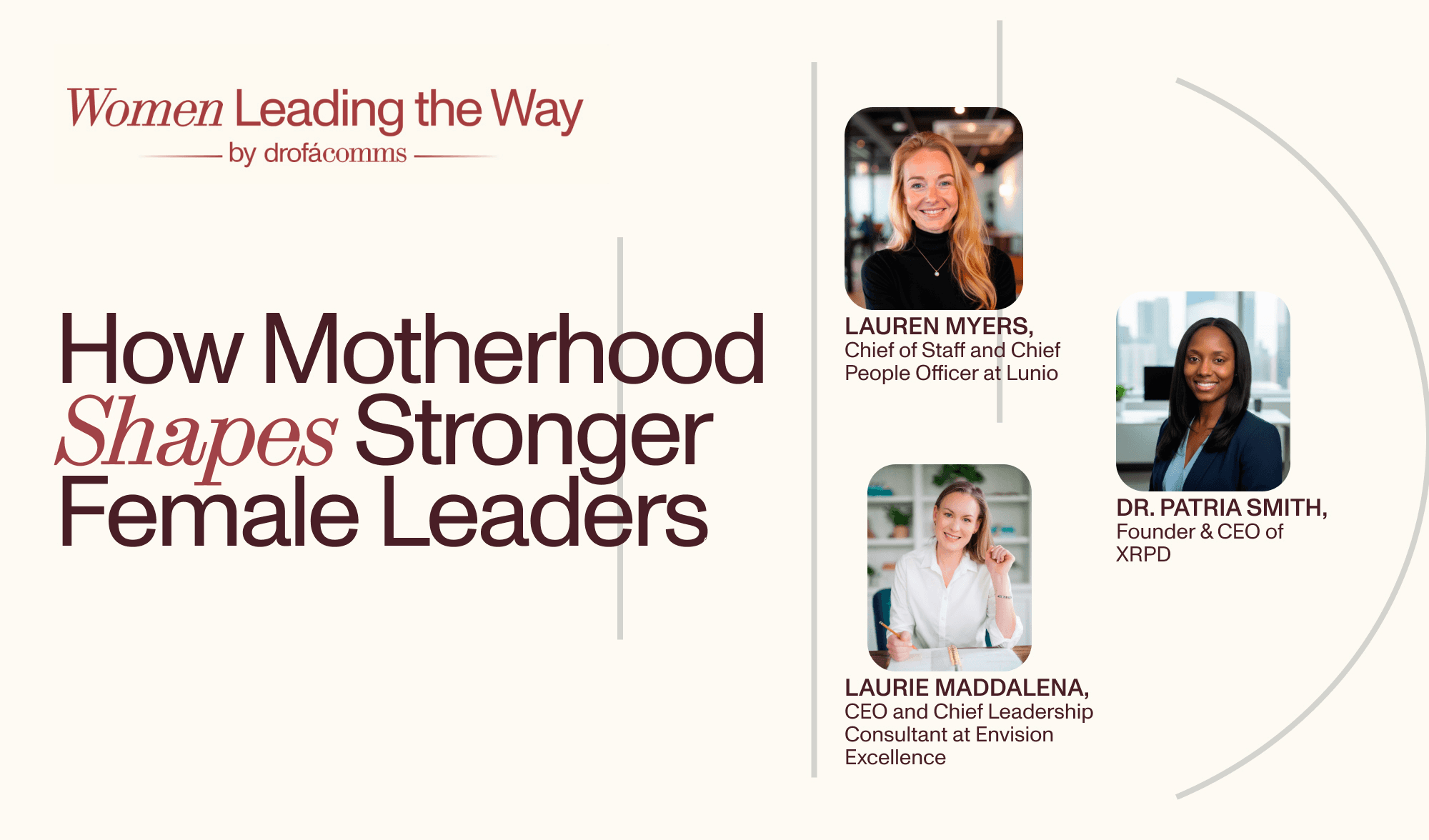
Female workers being torn between their workplaces and the demands of motherhood is one of the oldest topics discussed in business. But fresh research proves that past assumptions are already outdated, as 78% of mothers believe motherhood has actually made them better leaders instead of distracting them.
Their professional ambitions and the ability to contribute are evidently intact, so then why do working mothers continue to face persistent questions about their commitment to their careers?
Drofa Comms invited a number of female founders and senior leaders to speak on the topic — and the general consensus among them is that the experience of raising children has helped them hone many of the qualities businesses value most.
Motherhood Teaches You to Make Better Decisions
One of the biggest changes motherhood brings isn't necessarily greater patience or empathy, but decisiveness.
For Dr. Patria Smith, Founder & CEO of XRPD, becoming a mother fundamentally changed how she approaches decision-making.
“Before becoming a mother, I spent more time seeking the opinions of others before making decisions,” she says. “Motherhood changed that. It taught me to make decisions faster and with more confidence in the outcome.”
That experience has carried directly into leading a startup, where uncertainty is part of everyday business. Patria’s stance is that making timely decisions, even with incomplete information, often produces better outcomes than waiting and delaying action, which is its own risk.
Beyond decision-making, she also believes motherhood develops a remarkable range of practical leadership skills: "I lead faster, organise better, troubleshoot quicker, and stay calmer under pressure. There is no role in this world where you wear more hats than being a mother."
For her, motherhood has never been something to hide professionally — instead, it's become one of the experiences that strengthened her leadership.
Lauren Myers, Chief of Staff and Chief People Officer at Lunio, shares a similar view. Rather than viewing motherhood as something that transformed her personality-wise, she sees it as a practical training ground for skills she relies on every day at work: time management, focus, the ability to juggle competing priorities, and more.
As she puts it, getting three children out of the house can sometimes be just as hard as managing multiple stakeholders at work. It takes resilience and flexibility to be able to switch between completely different responsibilities within hours.
Leadership Becomes More Human
Another big point that came up in our conversations is the way motherhood changes how you see the people around you.
Laurie Maddalena, CEO and Chief Leadership Consultant at Envision Excellence, says becoming a mother reinforced even further something she already believed — that employees are people first, not simply resources or job titles. They navigate a lot of personal challenges and struggles outside of work.
When leaders understand the realities their employees face, they become better equipped to build cultures that balance accountability and humanity. “High performance and empathy are not opposites. In fact, the strongest cultures embrace both,” is what Laurie believes.
“In my experience, motherhood reinforces many of the same skills that are essential for effective leadership — listening, coaching, setting boundaries, navigating difficult conversations, and helping others build confidence and independence.”
Motherhood also taught her another important lesson: that leadership isn't about having all the answers. It's about creating an environment where other people can learn, grow, and thrive.
That approach remains valid whether you're raising children or leading a team. The strongest organisations understand that people achieve their best results when they feel trusted, respected and supported.
Flexibility isn't a Perk — it's Good Business
If there's one expectation motherhood changes, it's what leaders should provide in the workplace. Across all our conversations, one theme came up consistently: genuine flexibility matters.
As Myers puts it, today's working mothers are navigating something entirely new, building careers in ways their own mothers never had the opportunity to. And there is no clear blueprint for balancing both roles, so they have no choice but to figure it out as they go.
That means workplaces shouldn't simply “tolerate” caregiving responsibilities — they should actively create environments where talented professionals can succeed in both areas of their lives.
Maddalena similarly argues that organisations need to move beyond measuring commitment by visibility or hours spent online. Instead, they should evaluate people by outcomes and trust employees to deliver results in ways that work for them.
Flexible working, realistic expectations and supportive leadership aren't just benefits for parents. They can help organisations just as much when it comes to retaining talented people in the long run.
The Ambition Myth Needs to Disappear
Perhaps the strongest consensus we’ve seen among all three speakers was that businesses continue to underestimate working mothers. Too often, assumptions persist that mothers are less committed, less ambitious or less available for leadership opportunities.
Smith strongly rejects that narrative: “Since becoming a mother, I completed my Doctor of Pharmacy degree, became Board Certified, obtained licensure across 13 U.S. jurisdictions, led one of the largest remote pharmacy teams in healthcare, earned my business degree, built a consumer brand, and now lead a blockchain security company.”
Her experience clearly demonstrates that motherhood doesn't reduce ambition; if anything, it can sharpen it.
Myers echoes that sentiment. In her experience, becoming a mother doesn't diminish ambition, but gives it greater purpose. Working mothers often bring exceptional focus, determination and clarity into their careers because they understand the value of their time and the impact of their work.
“The job of a smart organisation isn’t just to support that. It’s to actively harness it,” is what she believes.
Conclusion
Based on everything above, we can conclude that a lot of the assumptions around working motherhood can be dismissed as myths and misconceptions. But as outdated as it may be, this perception is still there, and it still influences how many businesses evaluate talent.
That’s why it is important to keep bringing up and reinforcing the true picture: that motherhood develops resilience, confidence, adaptability and the ability to make decisions under pressure. All of which are qualities most firms actively seek in leaders.
Working mothers can lead — that much has already been proven. The challenge now is to make more organisations recognise that fact.
Acknowledgements: Women Leading the Way and Drofa Comms would like to thank Dr. Patria Smith, Laurie Maddalena, and Lauren Myers for sharing their perspectives and contributing to this article.
Female workers being torn between their workplaces and the demands of motherhood is one of the oldest topics discussed in business. But fresh research proves that past assumptions are already outdated, as 78% of mothers believe motherhood has actually made them better leaders instead of distracting them.
Their professional ambitions and the ability to contribute are evidently intact, so then why do working mothers continue to face persistent questions about their commitment to their careers?
Drofa Comms invited a number of female founders and senior leaders to speak on the topic — and the general consensus among them is that the experience of raising children has helped them hone many of the qualities businesses value most.
Motherhood Teaches You to Make Better Decisions
One of the biggest changes motherhood brings isn't necessarily greater patience or empathy, but decisiveness.
For Dr. Patria Smith, Founder & CEO of XRPD, becoming a mother fundamentally changed how she approaches decision-making.
“Before becoming a mother, I spent more time seeking the opinions of others before making decisions,” she says. “Motherhood changed that. It taught me to make decisions faster and with more confidence in the outcome.”
That experience has carried directly into leading a startup, where uncertainty is part of everyday business. Patria’s stance is that making timely decisions, even with incomplete information, often produces better outcomes than waiting and delaying action, which is its own risk.
Beyond decision-making, she also believes motherhood develops a remarkable range of practical leadership skills: "I lead faster, organise better, troubleshoot quicker, and stay calmer under pressure. There is no role in this world where you wear more hats than being a mother."
For her, motherhood has never been something to hide professionally — instead, it's become one of the experiences that strengthened her leadership.
Lauren Myers, Chief of Staff and Chief People Officer at Lunio, shares a similar view. Rather than viewing motherhood as something that transformed her personality-wise, she sees it as a practical training ground for skills she relies on every day at work: time management, focus, the ability to juggle competing priorities, and more.
As she puts it, getting three children out of the house can sometimes be just as hard as managing multiple stakeholders at work. It takes resilience and flexibility to be able to switch between completely different responsibilities within hours.
Leadership Becomes More Human
Another big point that came up in our conversations is the way motherhood changes how you see the people around you.
Laurie Maddalena, CEO and Chief Leadership Consultant at Envision Excellence, says becoming a mother reinforced even further something she already believed — that employees are people first, not simply resources or job titles. They navigate a lot of personal challenges and struggles outside of work.
When leaders understand the realities their employees face, they become better equipped to build cultures that balance accountability and humanity. “High performance and empathy are not opposites. In fact, the strongest cultures embrace both,” is what Laurie believes.
“In my experience, motherhood reinforces many of the same skills that are essential for effective leadership — listening, coaching, setting boundaries, navigating difficult conversations, and helping others build confidence and independence.”
Motherhood also taught her another important lesson: that leadership isn't about having all the answers. It's about creating an environment where other people can learn, grow, and thrive.
That approach remains valid whether you're raising children or leading a team. The strongest organisations understand that people achieve their best results when they feel trusted, respected and supported.
Flexibility isn't a Perk — it's Good Business
If there's one expectation motherhood changes, it's what leaders should provide in the workplace. Across all our conversations, one theme came up consistently: genuine flexibility matters.
As Myers puts it, today's working mothers are navigating something entirely new, building careers in ways their own mothers never had the opportunity to. And there is no clear blueprint for balancing both roles, so they have no choice but to figure it out as they go.
That means workplaces shouldn't simply “tolerate” caregiving responsibilities — they should actively create environments where talented professionals can succeed in both areas of their lives.
Maddalena similarly argues that organisations need to move beyond measuring commitment by visibility or hours spent online. Instead, they should evaluate people by outcomes and trust employees to deliver results in ways that work for them.
Flexible working, realistic expectations and supportive leadership aren't just benefits for parents. They can help organisations just as much when it comes to retaining talented people in the long run.
The Ambition Myth Needs to Disappear
Perhaps the strongest consensus we’ve seen among all three speakers was that businesses continue to underestimate working mothers. Too often, assumptions persist that mothers are less committed, less ambitious or less available for leadership opportunities.
Smith strongly rejects that narrative: “Since becoming a mother, I completed my Doctor of Pharmacy degree, became Board Certified, obtained licensure across 13 U.S. jurisdictions, led one of the largest remote pharmacy teams in healthcare, earned my business degree, built a consumer brand, and now lead a blockchain security company.”
Her experience clearly demonstrates that motherhood doesn't reduce ambition; if anything, it can sharpen it.
Myers echoes that sentiment. In her experience, becoming a mother doesn't diminish ambition, but gives it greater purpose. Working mothers often bring exceptional focus, determination and clarity into their careers because they understand the value of their time and the impact of their work.
“The job of a smart organisation isn’t just to support that. It’s to actively harness it,” is what she believes.
Conclusion
Based on everything above, we can conclude that a lot of the assumptions around working motherhood can be dismissed as myths and misconceptions. But as outdated as it may be, this perception is still there, and it still influences how many businesses evaluate talent.
That’s why it is important to keep bringing up and reinforcing the true picture: that motherhood develops resilience, confidence, adaptability and the ability to make decisions under pressure. All of which are qualities most firms actively seek in leaders.
Working mothers can lead — that much has already been proven. The challenge now is to make more organisations recognise that fact.
Acknowledgements: Women Leading the Way and Drofa Comms would like to thank Dr. Patria Smith, Laurie Maddalena, and Lauren Myers for sharing their perspectives and contributing to this article.
London office
Rise, created by Barclays, 41 Luke St, London EC2A 4DP
Nicosia office
2043, Nikokreontos 29, office 202
DP FINANCE COMM LTD (#13523955) Registered Address: N1 7GU, 20-22 Wenlock Road, London, United Kingdom For Operations In The UK
AGAFIYA CONSULTING LTD (#HE 380737) Registered Address: 2043, Nikokreontos 29, Flat 202, Strovolos, Cyprus For Operations In The EU, LATAM, United Stated Of America And Provision Of Services Worldwide
Drofa © 2024
London office
Rise, created by Barclays, 41 Luke St, London EC2A 4DP
Nicosia office
2043, Nikokreontos 29, office 202
DP FINANCE COMM LTD (#13523955) Registered Address: N1 7GU, 20-22 Wenlock Road, London, United Kingdom For Operations In The UK
AGAFIYA CONSULTING LTD (#HE 380737) Registered Address: 2043, Nikokreontos 29, Flat 202, Strovolos, Cyprus For Operations In The EU, LATAM, United Stated Of America And Provision Of Services Worldwide
Drofa © 2024
